05 August 2024
Part 7: The EU AI Act - what it means in practice for most companies
The EU AI Act - Regulation on Artifical Intelligence
The EU AI Act is causing a stir: critics see it as a regulatory monster, while its creators praise it as a shining example of global AI regulation that will promote innovation. Some companies have already started to implement it, although most of its provisions will not apply for some time yet. Nevertheless, it may also affect companies in Switzerland. An initial commentary.
The "EU AI Act" (AIA) of the European Union (Regulation (EU) 2024/1689) was published in the Official Journal of the European Union on 12 July 2024 and entered into force on 1 August 2024. It is also sometimes referred to as the EU's "AI law". It will take up to 36 months for all its provisions to apply. However, it is already becoming apparent that it will have an impact far beyond the European Union. Anyone using a service or product with artificial intelligence (AI) will align with it, at least if they hope to find customers in the EU or on the global market. It was preceded by several years of tug-of-war, which ended in a provisionally finalized text in February 2024.
1. Concept
Like the EU General Data Protection Regulation (GDPR), the AIA is a regulation, i.e. directly applicable EU law. Enforcement takes place both locally in the member states (each of which must designate a market surveillance authority and an authority to regulate the procedures of the bodies assessing product conformity) and centrally (for example, the EU Commission is responsible for general purpose AI models).
As with the GDPR, there are also central institutions such as the European Artificial Intelligence Board (EAIB), for which each member state appoints a delegate. A "Scientific Panel of Independent Experts" is to be created, as well as the central "AI Office" as part of the European Commission, which will support the market surveillance authorities, but will also, for example, provide certain templates and monitor certain topics such as compliance with the requirements in connection with general-purpose AI models. The European Commission as such also has supervisory tasks.
Whether and when the EEA states will also adopt the AIA is not yet clear.
It is not yet clear whether and when the AIA will apply not only to EU Member States but also to EEA States. The AIA applies to private organizations as well as public authorities which fulfil the respective requirements but not to military, defense and national security uses of AI, as these areas are still largely reserved for regulation by the member states.
Although the AIA is long (approx. 140 pages with the recitals and annexes) and, like almost every EU legal text, tedious to read, the regulatory concept is not particularly complicated. In a nutshell:
- First, a distinction is made between "AI Systems" (AIS) and "General Purpose AI Models" (GPAIM) - this primarily refers to models for generative AI such as "GPT" or "Llama").
- The personal and territorial scope of applications is defined, whereby a distinction is made in particular between those who offer AIS and GPAIM ("providers") and those who deploy them ("deployers").
- A few AI applications are banned entirely.
- Some AI applications are defined as being "high risk" ("High-Risk AI System", HRAIS): Certain requirements must be met by an HRAIS (e.g. quality and risk management, documentation, declaration of conformity), compliance is primarily the responsibility of the providers but a few obligations are also imposed on the deployers. It is estimated that only around five to ten per cent of all AIS will fall into this category; we assume that there will be even fewer in most companies, as most of them will steer clear of HRAIS - at least in the role of a provider.
- For all other AIS, some more general obligations are defined for both providers and deployers, mainly for transparency.
- The GPAIM distinguishes between:
- Not recorded at all (very few cases),
- "normal" (with some obligations for providers),
- and "Systemic risks" (with additional obligations for providers).
- A distinction is made between GPAIMs that are not covered at all (very few), "normal" GPAIM (with minimal obligations for providers) and those that entail "systemic risks" (with additional obligations for their providers).
- The European Commission maintains a central register of HRAIS and there are various regulations (including reporting obligations) to keep track of incidents related to HRAIS and to respond to such incidents if necessary.
- Accompanying instruments are envisaged, such as
- regulatory sandboxes (right to involve supervisors in the development of new AIS for early legal certainty),
- regulations/arrangements for testing AIS in the "real world",
- codes of conduct; and
- various provisions for the creation of standards, benchmarks and templates. How relevant they will be in practice remains to be seen. The greatest practical benefit is likely to come from the templates that the AI Office in particular is to create. Depending on how practical and detailed they are, they will either make compliance more difficult or easier for companies. The regulatory sandboxes, on the other hand, are likely to be more of a flop: it is not really clear how they should promote innovation, even if that is their stated aim. It is generally recognized that the early involvement of supervisory authorities in new technologies unfortunately often hinders innovation rather than promoting it, because they naturally have less technical and practical experience in the relevant issues and tend to apply stricter standards than the legislator intended when interpreting legal requirements. This has been proven in the implementation of the GDPR; to date, numerous EU supervisory authorities are attempting to extend data protection significantly beyond the legal level. It is becoming apparent that some of them will also be responsible for implementing the AIA. In this respect, the AIA will not promote innovation in the field of AI as hoped for or propagandized by the Commission but will primarily make it more expensive and more difficult, thereby increasing the barriers to market entry for small companies. The main positive aspect of the AIA regulation from an innovation perspective is that it provides a certain degree of legal certainty.
- There are some enforcement provisions that provide for investigative and intervention powers for market surveillance authorities, administrative fines (usually slightly lower than under the GDPR) and a right of access for individuals in the EU that are affected by negative AI-assisted decisions.
- There are provisions on entry into force and very few transitional provisions.
GPAIM are noticeably milder and less thoroughly regulated than AIS and are also dealt with separately, which is partly due to the fact that they were only included in the AIA after the initial draft had been proposed in mid-2021, i.e. before the hype surrounding "ChatGPT" & Co. and the Large Language Models (LLM) on which these applications are based. The GPT LLM is a classic example of a GPAIM.
The AIA is primarily a market access and product regulation, as it is familiar for various products with increased risks (e.g. medtech). This is in contrast to the GDPR, which primarily regulates behavior (processing of personal data) and data subject rights. Although a few general principles of conduct for using AI are defined in the AIA and affected persons are granted one particular "right" to information, these provisions are focused on very specific, limited use cases; even the "prohibited" AI applications are very narrowly defined. Instead, above all, the AIA regulates the accompanying measures that must be implemented in the case of AIS deemed to be particularly risky and how such AIS must be placed on the market, used and monitored.
Some HRAIS will be AIS that are part of already regulated products, in which case many of the obligations provided for by the AIA already apply in a similar way; the AIA regularly refers to them and provides for a coordinated implementation (for example with regard to risk and quality management, documentation and conformity declarations, but also with regard to regulatory supervision). The lawmakers at least tried to limit bureaucracy in these cases; however, it is questionable whether they succeeded. Nevertheless, the AIA repeatedly makes it clear that a risk-based approach should apply. Many of the requirements set forth by the AIA are rather generic, which leaves some wiggle room when it comes to their implementation as long as overzealous supervisory authorities do not wreak havoc here as they did with the GDPR.
The AIA repeatedly states that it applies in addition to existing laws and regulations, i.e. it does not restrict them in any way. This applies in particular to the GDPR. The AIA also does not in itself constitute a legal basis for the processing of personal data, with a few exceptions – namely when it would be "strictly necessary" ("reasonable" is not sufficient) to process special categories of personal data for testing and correcting an HRAIS (but not other AIS) with regard to a possible bias. Beyond that, the AIA contains hardly any provisions that deal with data protection; it is notable though, that the EU Data Protection Supervisor is to be assigned the task of AI market supervision over the EU institutions. It remains to be seen to what extent the EU member states will also entrust their AI market supervision obligations to their own existing data protection authorities. We estimate that this will be the case in around half of all cases.
What is also noticeable is that the legislator apparently had some difficulty in regulating the use of AIS by public authorities in the area of law enforcement and specifically in systems for the remote biometric identification of people in public (e.g. based on their faces or gait via cameras in public places). The use of these systems is permitted in certain cases and the AIA regulates this in much more detail than it does any other applications (although it should be noted that the area of national security is completely excluded from the scope of the AIA). Since all this will be less relevant for companies, we will not go into more detail on these and other governmental applications here.
2. Scope of application: What is an AI system?
Unfortunately, the scope of the AIA is anything but clear in various respects – and it is defined in an extremely broad manner.
This starts with the definition of AIS. It contains five elements, three of which apply to almost every IT application, namely that, in simple terms, a system (i) is machine-based, (ii) infers from an input how an output is to be generated, and (iii) this output can have an influence outside the system. This probably applies to any classic spreadsheet or image processing software, as they, as well, generate an output (result of calculations, images processed with filters) inferred from input (numbers and formulas, images) and it can have an influence outside the system. Every chip also has channels for input and output. The criterion of possible influence on the environment also appears to be limitless, because an IT system that has no influence on its environment is meaningless.
The further criteria are that the system (iv) may be able to adapt itself after its implementation (the AIA explicitly uses "may", as we understand it the system's ability to learn after its commissioning is therefore not a prerequisite), if it were mandatory, many AI applications that are supposed to be clearly recorded like "ChatGPT" would no longer be AIS, because their models are not continuously adapted, but are handed over to the users in a "frozen" state, so to speak) and (v) is "designed to operate with varying levels of autonomy".
This last element of the definition, i.e. at least partial autonomy, therefore appears to be the only really relevant distinguishing criteria that differentiates AI systems from other IT systems. Still, it is also not entirely clear what "autonomy" means. In our view, it draws a distinction between systems whose output is generated from the input entirely according to rules that have been formulated by humans, i.e. a deterministically or fully statically programmed system ("if-then-systems") and other systems, i.e. systems that, for example, use pattern recognition based on their training to determine the output. In those cases, the (human) deterministic or static programming no longer or no longer alone determines the output that results from the input but a process of machine learning; the decision logic comes only indirectly from humans, who explain to the machine how it must learn and make its own decisions based on what it has learnt in individual cases; not every decision is therefore predetermined by humans. The recitals seem to support this view. While most people think of static code as code written by human programmers, it is also possible that such code has been programmed by an AI. A system with deterministic decision logic and conduct programmed by an AI is therefore not an AIS because it lacks autonomy. This leads to the interesting question of how the AIA regulations could be circumvented in this way, for example by commissioning an AI system to develop a system based on its knowledge that is based on a deterministic programming, but nevertheless is so complex that we humans no longer understand its function or decision-making logic (we assume that the drafters of the AIA did not think about such things; had they done so, they would have ruled this out as well).. For the time being, however, we have to assume that the applicability of the AIA can, in principle, be prevented by only using systems that do not act autonomously in the above sense, even if they lead to the same result or do equally problematic things as an AIS.
Put simply, every IT system that fulfils its function (more precisely: how it generates a certain output from a certain input) not only on the basis of pre-programming, but at least partially on the basis of training, is an AIS. This also closes the circle of those who consider the "inference" from an input to an output to be the essential criterion; it is the same understanding, just from a different perspective. We do not consider the fact of inference to be decisive, but the way in which it happens – at least partly based on training, not classical programming, and therefore at least partly autonomous.
This makes the scope extremely broad. It includes, for example, any system that contains a neural network or other machine learning process in order to generate output or make decisions based on it. AIS therefore includes even such banal applications as character recognition (OCR) in a photocopier or PDF reader, the use of a fingerprint sensor on a computer or mobile phone to unlock it, or the algorithm that interprets our input in an Internet search engine in order to convert it into a suitable search command. In many instances, companies and even more so "normal" users will not even realize that they have been working with AIS for many years. Even the use of comparatively simple and straightforward methods such as "Random Forest" can turn an IT system into an AIS, at least if "autonomy" is understood, as explained in the recitals, to mean that a system does not make its decisions solely on the basis of a decision made by a programmer. Where exactly the distinction between AI and non-AI is to be drawn is not a trivial matter, however. If software uses the "linear regression" method to predict, for example, how many guests are to be expected at what weather conditions based on previous temperature and visitor figures for an outdoor pool, hardly anyone would describe this as AI, but rather as pure statistics: the previous empirical values and forecast temperature are the input for the program's formula and the calculated number of guests its output; it could also be said that "training" and evaluation are only carried out by the user and not by the person who provides the system. In reality, however, classic machine learning methods can also be described as mathematical functions, but they are often more complex. The criterion of "autonomy" or the differentiation between training and programming therefore does not allow a clear distinction to be made.
While the AIA does not regulate the vast majority of AIS, its definition of what constitutes "AI" is likely to be widely accepted despite its vagueness; it is also similar to the OECD's definition of AI. This makes it all the more important that companies and supervisory authorities are aware of the breadth of the term when regulating AI, including the fact that it encompasses many applications that they may not even think about when drafting their regulations and that do not fit.
The definition of GPAIM is even more vague than that of AIS. It does not even state what an "AI model" is. An AI model becomes a "general purpose" AI model if displays "significant generality" and is therefore capable of competently performing "a wide range of distinct tasks regardless of the way the model is placed on the market" and can be integrated into a variety of systems and applications.
Finally, a practical note: Most of the provisions in the AIA refer to an AIS, i.e. a "system". However, most of these provisions in the AIA also require the system to be used for its intended purpose, for example for a specific high-risk application (e.g. calculation of a credit score). In practice, however, the combination is no longer referred to as a system, but as an application or "use case". The distinction will be of practical relevance insofar as, assuming good governance, companies will keep corresponding registers of their AI activities and the question arises as to whether these are kept by system or by application. Even if the AIA distinguishes between systems, an inventory by application, i.e. by use case, often proves to be more useful for the purposes of AI governance, because a system is generally not purchased without an application (even generic tools such as "ChatGPT" have one), the application defines the legal consequences, and each application typically has its own internal "owner".
3. Scope of application: Who is considered a provider?
As already mentioned, the two most important roles in which an organization can become subject to the AIA separately or simultaneously are that of the provider and the deployer. Although there are other roles such as importers, distributors and product manufacturers as well as the EU representative, they ultimately be attributed to the provider. The market surveillance authorities can take action against all of them, and all of them must co-operate with the authorities.
It is essential that an organization identifies its role for each AIS or GPAIM it deals with, as this role will determine its obligations under the AIA. Most of the obligations are imposed on the provider (see below).
The provider is primarily the party that (i) develops an AIS or GPAIM (itself or on behalf of others), and (ii) places it on the market or puts it into service it under its own name or trademark:
- "Placing on the market" refers only to the EU market and means the first making available of an AIS or GPAIM on that market.
- "Putting into service" also refers only to the EU. It means the initial supply of an AIS for first use directly to a deployer or for (first time) use by the provider (this second criterion does not apply to GPAIM because under the AIA these models are considered only a preliminary stage of an AIS).
- In both cases, the activities presumably must have been directed towards the EU; a "non-intentional spill-over" to the EU market is not sufficient.
- It does not matter whether the AIS is offered for a fee or free of charge.
Prior to this happening, the research, development and testing on and of an AIS is not subject to the AIA, with the only exception being field trials, also referred to as testing in the "real world" (there is a separate section in the AIA regulating these trials).
This definition has some implications. Anyone who has developed an AIS and neither places it on the EU market nor supplies it for its own or a third-party use in the EU can, thus, not be considered a provider according to the definition of the AIA, even if the AIS finds its way into the EU or has effects within the EU. This even applies to companies located in the EU. While this seems logical based on the AIA's definition of "provider", it creates a loophole because the AIA's territorial scope has been defined more broadly: According to it, providers located abroad should also be covered if the output of their AIS is by intention used in the EU. This provision was to prevent the circumvention of the AIA by AIS that have effects in the EU but are operated outside the EU. The provision, however, cannot apply to providers because the legal definition of what constitutes a provider already presupposes an EU market connection. It will be interesting to see how the market surveillance authorities deal with this legislative oversight, given that the intention of the legislator is as clear as the contradictory wording.
However, there is one area of application for the aforementioned "anti-circumvention" provisions of the AIA: It applies to those who exceptionally become a provider because they (i) "put" their name or trademark on an HRAIS (whatever this means) that is already on the EU market, (ii) substantially modify such an HRAIS (but it remains an HRAIS) or (iii) modify or use an AIS on the EU market contrary to its intended purpose in such a way that it becomes an HRAIS. An example of the latter is the use of a general purpose chatbot for a high-risk application (e.g. when "ChatGPT" is used in the EU to analyze CVs of job applicants). The original provider is then no longer considered the provider. In this case, the aforementioned provision will cover such providers if they are based outside the EU, but the output of the AI is used as intended in the EU. If this were not the case, it becomes questionable whether these "secondary" providers still fall within the scope of the AIA if they themselves did not place the AIS on the EU market and have not used it there. This would be yet another loophole in the AIA.
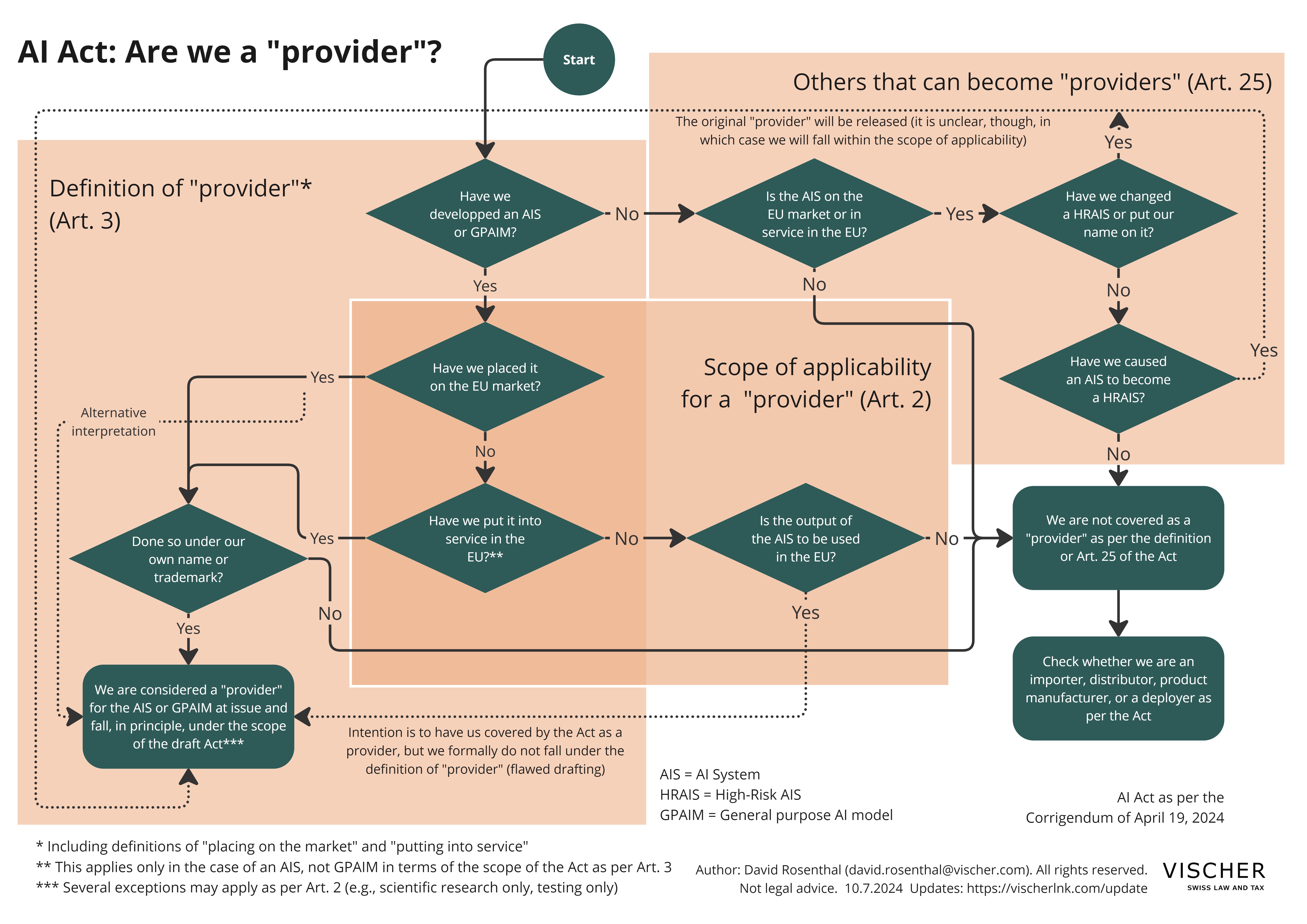
Some legal writers have argued that the AIA directly or indirectly regulates every AIS that affects persons in the EU. According to the view expressed here, this is not the case. It is true that the AIA explicitly applies to all affected persons in the EU. However, this does not automatically mean that it also applies to all providers, deployers and other persons; their personal and territorial scope of application is defined separately and in a distinct manner by the AIA. If every AIS (including its providers, deployers and other persons involved) were automatically subject to the AIA, the differentiations of the rules discussed above would not have been necessary in the first place. Rather, the inclusion of the "affected persons" in the definition of the AIA's scope is necessary so that they can assert their (few) rights under the AIA.
The cases in which an AIS has been created by more than one provider or where the AIS of one provider contains an AIS of another provider are regulated by the AIA only in a very rudimentary manner. The AIA provides that the provider should conclude a contract with its "sub-provider" that enables the provider to comply with the AIA; the sub-provider will presumably be covered independently pursuant to its own market activities. Furthermore, anyone who places on the EU market or puts into service in the EU an AIS with another product, is considered a "product manufacturer" under the AIA and – if it is a HRAIS (e.g. because it is a safety component of a regulated product) – will be considered its provider as per the AIA. Hence, not only the person who (i) first develops an AIS can be its provider, but also the person who (ii) further develops it and (iii) incorporates it into a new AIS or other product.
What happens if someone (co-)develops an AIS but does not place it on the market or put it into operation in the EU under their own name or trademark, but that of another party, is also not entirely clear. Formally speaking, this entity cannot be a provider because a mandatory criterion of the legal definition is not fulfilled. Although the AIA recognizes certain forms of "joint" responsibility, it does not go as far as in data protection, where it is also possible for two entities to be jointly responsible for a processing activity even though there is a division of responsibility between them. Something similar should also apply here, but as far as can be seen, there is no legal basis for this; only the co-operation of several bodies is regulated, each of which is also considered a provider in its own right. However, the case can be solved using auxiliary constructions:
- Anyone who, without authorization, displays the name or trademark of another person on the AIS they have developed and thus essentially arrogates it to themselves will probably be treated as if it were their own name or trademark in terms of liability as a provider. He would have to be regarded as a provider - if only on the basis of the principle of good faith.
- On the other hand, anyone who (co-)develops an AIS but is authorized to affix the name or trademark of another party can, in our opinion, justifiably argue that he has merely acted on behalf of the other party, who is deemed to be the provider; stating his name or affixing his trademark - or authorizing a third party to do so - is to a certain extent a declaration that he assumes the provider's responsibility for the AIS.
4. Scope of application: Who is considered a deployer?
Business users of AIS are referred to as "deployers" under the AIA and are subject to only a few obligations (see below). A deployer is anyone who uses an AIS under its own authority. Exempt are those persons who use an AIS only for personal, non-professional activities (although here, too, the drafting of the AIA was somewhat careless – this exception exists on two levels and is formulated slightly differently).
The criterion "under its authority" in our view distinguishes the mere "enjoyment" of an AIS and its output from the use of an AIS as a tool under its own control. Hence, a certain degree of control will be required for the criterion to be met because control leads to responsibility. If a user uses a customer service chatbot on a website, they do not have this control; at least no such control is intended. They can ask questions and the company controls how the chatbot answers them. It would only be different if the user managed to "hack" the chatbot and cause it to make unintended statements. If, on the other hand, a company provides its customers with an AI functionality as part of a service that they can and should control for their own purposes within certain limits, then the "under its authority" criterion is likely to be met in our view. If a company such as OpenAI offers its customers the chatbot "ChatGPT", this differs from the customer service chatbot mentioned above in that it is the OpenAI customer who should instruct the chatbot what to talk about and no longer the company that operates it. Where exactly the line is to be drawn (e.g. in the case of expert chatbots) is, of course, not yet clear. It makes sense here to draw on the practice of the comparable concept of the "controller" in data protection, which also derives the (sole or joint) responsibility in this respect from the control over the purpose and the (essential) other parameters of a data processing activity.
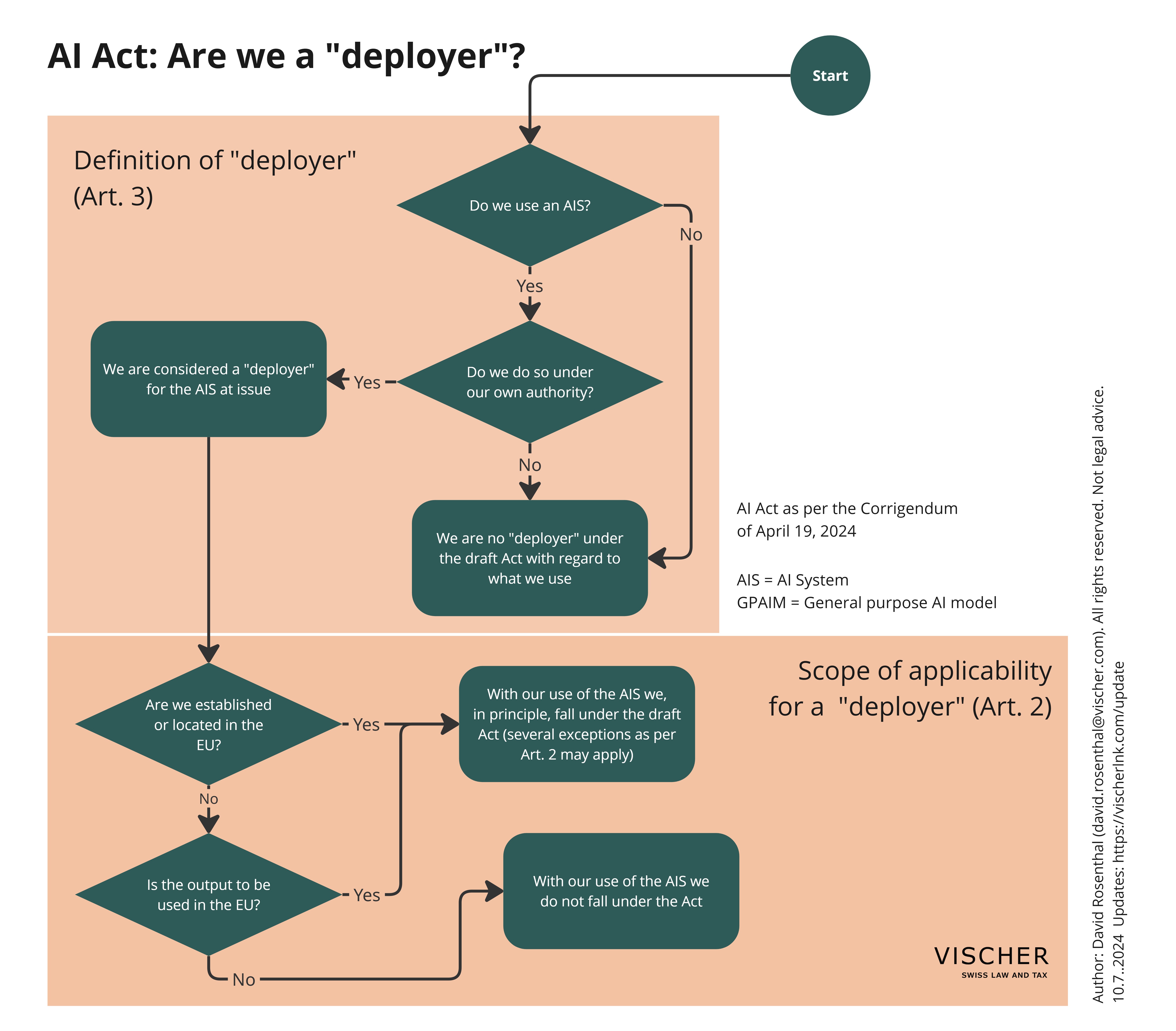
The territorial scope of the AIA covers all those deployers who are either in the EU (whether with an establishment or because they reside there as natural persons) or, if they are not in the EU, those whose output of the AIS they operate is "used" in the EU. According to the recitals, the latter rule is intended to prevent circumvention of the AIA by providers in third countries (such as Switzerland or the USA) who collect data in the EU or receive it from there, process it with AIS in countries outside the EU and send the result back to the EU for use without the AIS being placed on the market or put into service in the EU. The example itself raises questions, as a company based in the EU that asks a company in another EU country to process data with an AIS on its behalf will probably still be considered its deployer, just as the actions of a processor are attributed to the controller in the area of data protection. The exemption is likely to be much more relevant for those companies that are located in other countries outside the EU (e.g., Switzerland or the USA) and use AIS for themselves. Either way, the AIA is intended to protect natural persons affected by the use of AIS within the EU. According to the recitals, it is necessary that the AI output was intended to be used in the EU and the use is not merely coincidental.
What exactly counts as "use" of AI output in the EU is not specified in the AIA. Whether it is sufficient that the AI output merely has an effect on persons in the EU is a conceivable interpretation, but in our view rather questionable. Some examples:
- Anyone who publishes AI-generated content on a non-EU-website that (also) targets users in the EU audience is likely to be covered by the rule. The same applies to AI-generated content in advertising materials that are also intended to appeal to customers in the EU.
- Companies that send texts generated by an AIS to customers in the EU are also likely to be covered.
- If a document created by an AIS outside the EU somehow finds its way into the EU by chance, then the rule should not apply to the deployer of the AIS.
- However, content generated by a computer, but neither directly nor indirectly by an AI, should not be covered.
- In our opinion, the possibility that AI output may enter the EU via the right of access under data protection law is also not sufficient to establish a link; although this may occur, it would generally not be an intended use.
- The use of an HRAIS or the implementation of a practice prohibited under AIA by a Swiss employer in relation to its Swiss employees should not become subject to the AIA according to the rule even if employees living in the EU are affected, provided that the Swiss employer makes use of the AIS' output only at the company's offices in Switzerland.
- However, if the employer uses a cloud or cloud provider located in the EU for storing the output, the legal situation may be different. Yet, it is still unclear whether the outsourcing of the operation of an AIS to a provider based in the EU or a provider using a data center in the EU will mean that the output of the AIS is deemed to be "used" there. We do not believe that this is nor should be the case: In view of the purpose of primary purpose of protection, namely the protection of the health, safety and fundamental rights of natural persons in the EU (only they are in focus), the outsourcing of IT operations to the EU as such cannot be sufficient because this alone does not affect them in any way. There is no connection to the persons affected. The criterion of the use of the output in the EU is intended to cover those cases in which the output is generated outside the EU but "reaches" data subjects in the EU. This is not the case here. Also, the mere commissioning of a service provider in the EU does not constitute an establishment in the EU (nor does it under the GDPR). The secondary protection objectives of the AIA will also include the protection of democracy, the rule of law and the environment, but even these do not really justify an extension of the scope; in terms of the environmental protection objective, the energy consumption of data centers for AI would most likely come into question, but the AIA itself does not contain any really relevant provisions in this respect. It should be noted, however, that a provider that also offers AI functionalities as part of its cloud services may itself be subject to the AIA, even if its customer as deployer is not. This is also the case in the area of the GDPR for providers based in the EEA; they are subject to the GDPR, but their Swiss customers may not be.
Irrespective of the remaining uncertainties, the regulation of the use of AIS output in the EU leads to a significant extraterritorial effect of the AIA. This means that many Swiss companies should also be concerned with complying with the transparency obligations that are imposed upon deployers under the AIA. With regard to a possible role as a provider, however, they can take the position, as mentioned above, that they are not covered if they neither placed the AIS on the EU market nor put it into service in the EU.
5. Further distinctions that may be relevant in practice
The above AIA definitions raise further issues, particularly where companies develop AIS themselves, use them for interactions with third parties or pass them along within a group of companies.
First, it is unclear what constitutes "developing" an AIS. For example, is this criterion already met if a company parameterizes a commercial AI product for its own application (e.g., providing it with corresponding system prompts), fine-tunes the model or integrates it into another application (e.g., by integrating chatbot software offered on the market into its own website or app)? If this were the case, then many users would become providers themselves, as the legal definition of provider also covers those who use AIS for their own use, provided that this use takes place in the EU as intended and under their own name. Although such a broad understanding is not correct in our view, it is to be feared that the market surveillance authorities will take a broad view and at least consider as development those actions that go beyond prompting, parameterization and the provision of other input. This means that any fine-tuning of the model of an AIS would be deemed further developing the AIS (because, to a certain extent, the training knowledge and thus the programming is changed) whereas the use of "Retrieval Augmented Generation" (RAG) would not (because only the input is changed here). It would also be possible to argue that a distinction should be made based on the risk posed by the contribution in each case, but doing so would lead to considerable legal uncertainty, as the same action would result to the person acting being qualified differently depending only on the purpose of the system. It should be noted that the deployer in any event remains liable to a certain extent.
Until the legal situation has been clarified, companies are advised as a precautionary measure to also state the name of their technology supplier externally when using such AIS (e.g. "Powered by ..." for a chatbot that is offered to their own customers as a service on their website). This way, it can be argued that the AIS – even if the implementation or fine-tuning were considered a development – is not used under the user's own name or trademark. However, this should only be done with the permission of the technology supplier, as they must be prepared to take on the role of provider and the associated responsibility (i.e. the customizations must be attributed to them alone). Another possible precautionary measure is to restrict the authorized use of an AIS to persons outside the EU, as the legal definition of the provider would then presumably no longer apply.
It is also unclear how the transfer of AI services or AI technology within a group of companies should be assessed. Various tricky scenarios are conceivable here. One scenario is the case in which group company X outside the EU purchases an AIS from provider Y outside the EU and then makes it available to other group companies in the EU. If the AIS has not yet been placed on the EU market or put into service in the EU, X can be deemed its "distributor" or even "importer" without having further contributed to its development. This would entail a number of special obligations. While X can probably prevent being classified as an importer (and provider) by only passing along AIS to the EU that already are on the EU market, this does not protect X from being classified a distributor. It can at least be argued that the legal term presupposes that the company is part of the "supply chain" of Y mentioned in the definition and that this does not reasonably entail any intra-group distribution of an AIS to group companies of X. They also do not make the AIS publicly accessible, as a distributor does, but only internally within the group.
We have already discussed the question of whether a Swiss company can fall under the AIA simply because it has its AIS operated in a data center in the EU or because it operates the AIS in Switzerland but the data center is provided by a cloud provider in the EU (para. 32). In these cases, however, the question may also arise as to whether outsourcing to an EU cloud should not be considered as "putting into service" of the AIS concerned in the EU, because it is sufficient for the AIS to be made available for the first time for own use in the EU. If the company has developed the AIS itself (or had it developed) and uses the AIS under its own name, the two other conditions would be met in this case and it runs the risk of being considered a provider of the AIS under the AIA, even if it is only for its own use and is based in Switzerland. To reduce this risk, Swiss companies should therefore preferably operate AIS in data centers outside the EU, even if the operating company (e.g. the cloud provider) is itself based in the EU. And there is something else Swiss companies should bear in mind: employees who are in the EU when using AIS, which could lead to the applicability of the AIA (e.g. when working from home or travelling).
In the corporate context, the question may also arise as to the point at which a company that makes a product with AI-supported functionality available to its customers is itself considered a provider and the customers are considered deployers. The hurdles are not very high: Take the example of a bank outside the EU that offers its EU business customers an AI-supported analysis of their portfolios in its online banking and trading application, being part of the bank's commercial service. If the bank has developed this functionality itself or has had it developed, it will already be considered a provider due to its own use, especially since it uses it (at least according to a broad understanding of the term) in the EU (but see below)and does so under its own name.
The customers who use the AI analysis function can in turn become deployers and be subject to the AIA, even if the bank itself does not care about the AIA. Two conditions must be observed here: First, the customers must be located in the EU or the output of the AI analysis must be used in the EU. Second, they must use the AI function under their own authority (see above). If the bank client (business client do not fall under the AIA exception for personal, non-professional use) thus obtains the necessary control over the AI function, it will have to ensure (and want to ensure) under its own responsibility that it is not engaging in a prohibited AI practice and that any applicable deployer obligations are complied with. The difficulty in practice may be that EU deployers may not even know where and when AIS are used in the products and services they use, if the providers of these products and services are from outside the EU.
In this context, the question may also arise as to whether a provider can logically only exist if there is also a deployer to which the provider makes the AIS available. The answer to this is probably "no". Otherwise, all providers that only offer AI services to consumers in the EU would not be covered by the AIA because such users are not considered deployers by virtue of an exemption. The definition of provider does not require a deployer: On the one hand, it is sufficient to put into service an AIS for own use in the EU. In order to fulfil this, it is presumably sufficient for the provider to target users in the EU and let them use the AIS as a service; it will be considered the provider's use own of the AIS because it remains the provider's service even from a user's perspective (the conclusion that this already constitutes own use in the EU is, in our opinion, not compelling, but is likely to be advocated in view of the protective purpose of the AIA; this would mean that a chatbot offered to an EU audience merely via a website would already lead to own use in the EU, i.e. remote access from the EU would qualify as local use; this could be countered by the fact that the legislator did not assume that this would be sufficient, which is why it defined the use of AIS output in the EU as a separate jurisdictional criterion, which would in any case apply to the deployer here). On the other hand, the alternative criterion for qualifying as a provider under the AIA (the "making available on the market") is fulfilled if an AIS is supplied "for … use on the Union market in the course of a commercial activity", which will likely be assumed to be the case here. However, this question has not been conclusively clarified either.
6. Prohibited AI applications
Eight specific "AI practices" are completely prohibited under the AIA. In most cases, the ban covers all those who place the AIS in question on the market in the EU, put it into service in the EU or simply uses it (which, as shown, also includes those who use them abroad, provided that the output of the AIS is also used in the EU as intended).
The list of prohibited AI practices is very specific:
- Use of subliminal, purposefully manipulative or deceptive techniques, with the objective or the effect of materially distorting behavior or impairing the person’s ability to make an informed decision, that may result in a decision that causes or is reasonably likely to cause significant harm. There does not have to be any intention to cause harm. Permissible applications in the medical field are not covered.
- Exploiting vulnerabilities or the need for protection of persons due to age, disability or a specific social or economic situation, to substantially change their behavior in a manner that may cause or is reasonably likely to cause significant harm.
- Biometric categorization to deduce or infer a person's race, political opinion, trade union membership, religious or philosophical belief, sex life or sexual orientation (i.e. based on biometric data). In other words, it is a matter of drawing conclusions about (in this case sensitive) "inner" values from "outward appearances", which is considered forbidden in particular because it is unreliable even with AIS. The analysis of a person's text, for example, is not biometric categorization, but the analysis of their voice is. The use of AIS to recognize biometric features as such, e.g. all persons with green eyes, is also not prohibited.
- Evaluation or classification of persons (individually or in groups) over a period of time based on their social behavior or known, inferred or predicted personality characteristics with this social score leading to detrimental or unfavorable treatment that is unrelated to the original data context, or with regard to their social behavior or its scope unjustified or disproportionate.
- Real-time remote biometric identification in publicly accessible spaces for the purpose of law enforcement, except for the targeted search for victims of certain criminal offences, the prevention of specific, substantial and imminent threats to life or physical safety or a terrorist attack or the localization or identification of suspects of certain defined categories of crimes (Annex II), subject too additional conditions (e.g., court approval, permission only to search for specifically targeted individuals).
- Profiling or assessment of personality traits or characteristics of persons to assess or predict the risk of them committing criminal offences, except for assisting human risk assessments of specific persons involved in a crime.
- Creation or expansion of a facial recognition database based on untargeted scraping on the Internet or CCTV footage (i.e. surveillance cameras). The legislator seems to have had providers such as "Clearview" and "PimEyes" in mind here.
- Inferring emotions (including intent) of persons in workplace areas or in education institutions except where intended for medical or safety reasons. According to the text, it does not matter whether the emotion recognition is based on biometric data (e.g. voice, facial expression) or other data (e.g. content of emails or other texts). However, this is not completely clear. Even in the case of HRAIS, where emotion recognition systems are also covered, the text does not differentiate, but it is clear from the recitals that only emotion recognition based on biometric data is meant there.
It should be noted that these practices are only prohibited if they are carried out using an AIS. For example, anyone who carries out emotion recognition in the workplace solely on the basis of self-programmed "if-then" rules (i.e. no pattern recognition) is not covered. Moreover, the practices are formulated very specifically, so that exceptions quickly arise. For example, the use of AIS to catch students actually cheating in an exam is for example not covered by the prohibition on emotion recognition (although this is a high-risk application). However, an AIS that is designed to detect pupils before they cheat would be a prohibited practice. If an AIS detects a pupil's nervousness so that the teacher can keep a close eye on them, this would be a prohibited practice because nervousness is an emotion. Lie detectors would also be covered. Incidentally, the reason for the ban here is also the unreliability of detection and the associated risk of inaccuracies and discrimination.
Examples of emotion recognition are also conceivable in the workplace, which can occur in practice and are by no means unusual. One example is the analysis of conversations in a call center. For quality control and training purposes, sentiment analyses are often carried out to determine the mood of callers (positive, neutral, negative). If this is only done using the caller's voice (e.g. live), the call center employees are not affected (however, the application would otherwise be recorded by the AIA). However, if the evaluation is carried out retrospectively using a transcript of the dialogue, it is possible, depending on the programming, that the mood or emotion of the call center agent is also indicated in the summary for the supervisor. This would be inadmissible, at least if no differentiation is made as to whether the emotion recognition is based on biometric data.
Anyone who uses an AIS to carry out "data loss prevention" (DLP) is not carrying out a prohibited practice, even if the theft of data can be a criminal offence and DLP can therefore be seen as including an assessment of the risk of a criminal offence in the broadest sense. Yet, because the intended purpose is not the assessment such risks, but the prevention of an unintentional loss of data, the prohibition does not apply, regardless of whether there is a criminal offence (moreover, the prohibited practice no. 6 above is aimed at "predictive policing" and not at the prevention of offences in progress). However, the AIS must function in such a way that it detects indications of data theft (e.g. transmission of certain business files to a private e-mail address) and not indications of an employee's emotions or intentions to commit such theft (e.g. searching for patterns according to which the employee is angry with his employer, is frustrated at work or has resigned internally, i.e. no longer shows loyalty). Fatigue, on the other hand, is not an emotion. So, anyone who uses AI to recognize tired employees is allowed to do so. However, the use of AI to recognize stress in the workplace is not permitted.
Another example: In the case of prohibited practice no. 1, it is not enough for people to be manipulated by means of AI. It must also be done for the purpose of significantly influencing their behavior, preventing them from making informed decisions, and it must also lead to a decision that can cause significant harm to the person. The recitals even state that "common and legitimate commercial practices" in the area of advertising are not covered here.
The case is somewhat less clear with practice no. 4 (scoring), which can be understood quite broadly because it merely presupposes unfavorable treatment. However, the prohibition only applies if the data has nothing to do with the treatment in question or if the unfavorable treatment is disproportionate or unjustified. It will be interesting to see whether, for example, AI-supported functions to calculate the "sweet spot" price for each visitor of an online shop based on their behavior will be covered. One way to avoid the prohibition would be to use a system that makes judgements based on rules rather than training.
In the case of practice no. 4, the question remains whether and when it refers to AI-based credit scoring and would therefore prohibit it. Although a person's ability to pay is not a social behavior or a personal characteristic, their willingness to pay can be. This would therefore cover anyone who places an AIS on the market which, for the purpose of determining whether credit should be granted to a person, identifies correlations between a person's behavior and their presumed unwillingness to pay, using data from a context that has nothing to do with the person's willingness to pay or where the data usage would be disproportionate or unjustified. To counter this, the credit scoring solution provider would, of course, argue that its solution is not intended to answer the question whether a person is willing to pay, but whether it will likely pay or not. Yet, the assessment whether someone is "more likely than not to pay their bills" could arguably be understood as a "social score". If this were the case, it would have to be demonstrated that only data collected in the context of paying bills has been used to make the assessment and that the credit scoring is actually reasonably accurate and the consequences are justifiable. Notably, such an application would nevertheless be covered as a HRAIS (see below).
It is not clear whether the legislator actually intended practice no. 4 to go as far as could be inferred from the broadly worded provision as shown. In any case, it states in the recitals that the prohibition "should not affect lawful practices for the assessment of natural persons carried out for a specific purpose in accordance with Union and national law." The cryptic wording is probably to be understood as meaning that they only wanted to prohibit extreme cases - such as those practiced in China. The statement could be understood to mean that whenever an assessment or profiling of a natural person is, firstly, compliant with data protection and other legal requirements (under EU law) and, secondly, the data has (also) been collected for the specific purpose for which it is processed, the AIA should not be prohibited from making the assessment. Therefore, if the online shop mentioned above states in its privacy policy what it intends to do with the data of the data subjects, even if this has nothing to do with the content at first glance, and if it also otherwise fulfils the requirements of the GDPR (insofar as it is applicable), then the use of an AIS for this purpose would not be prohibited.
7. High-risk AI systems
Two types of AIS are considered "high-risk AI systems" (HRAIS). First, HRAIS are generally those AIS that already require a third-party conformity assessment prior to distribution or use in accordance with the EU regulations listed in Annex I of the AIA , as well as those AIS used as a safety component of such regulated products (the term "safety component" also includes those AIS whose failure can lead to a risk to the health or safety of people or property). In these cases, the requirements of the AIA supplement the rules that already apply to these products. Examples of such products include medical devices, toys, radio equipment, recreational craft, aircraft, vehicles, railways and lifts.
Second, all AIS listed in a further annex to the AIA are considered HRAIS, too. As with the prohibited practices, these AIS are defined very specifically, which is why the list will be regularly reviewed and amended if necessary. The list currently includes the following applications (the decisive factor in each case is whether an AIS is intended to be used for the purpose described). The areas of application are usually defined in the relevant annex, and then the individual high-risk cases covered are described in more detail:
- Remote biometric identification using AI that goes beyond mere authentication, or biometric categorization using AI that uses sensitive or protected characteristics or attributes derived from such characteristics. This refers in particular to applications for facial recognition via camera images that are processed in a control center, but not systems for biometric access control or systems that are intended to ensure that only authorized persons have access to a computer system.
- Inferring emotions or intentions based on biometrics based on biometric data using AI. Annex III only mentions "emotions", not "intentions", but the latter are always mentioned in the definition of the term and in the recitals. It does not matter whether personal data is processed or not. Examples could include recognizing emotions in a vending machine, a video game or a medical diagnosis system. Emotions include happiness, sadness, anger, surprise, disgust, embarrassment, excitement, shame, contempt, satisfaction and pleasure. However, the recognition of pain and fatigue is not covered, nor is the recognition of gestures and movements, for example to control a system. The recitals also state that biometric systems that are exclusively intended to implement measures for cyber security and the protection of personal data should never be considered HRAIS. The regulation on emotion recognition is misleading in that Annex III refers to "AI systems intended to be used for emotion recognition" and not the defined term "emotion recognition system". This is relevant insofar as the latter term necessarily presupposes that the emotion is recognized on the basis of a person's biometric data, for example their facial expression, voice or movements. However, the same is meant in both cases, i.e. the regulation on HRAIS also means emotion recognition only on the basis of biometric data, as can be seen from the recitals. This can be of considerable practical relevance when it comes to recognizing emotions on the basis of the general, non-personalized meaning of a person's texts. So, if in the call center example mentioned above, a conversation is first transcribed for a sentiment analysis and only analyzed in this form by an AIS, this would not be HRAIS if the content of what someone says is no longer considered biometric data. Personal data relating to the physical, physiological or behavioral characteristics of a natural person is considered as such. In order for a text-based sentiment analysis to be recognized as emotion recognition, it would have to be shown that the statements and phrases used by a person are "behavior-typical" characteristics and are evaluated for the sentiment analysis. This will not normally be the case. In our opinion, what is meant here are constant, individual, measurable characteristics of this person that occur in every person, such as their voice (i.e. certain aspects of it, such as accent or intonation), signature and lip movements, their typing behavior on keyboards or their gait dynamics. In the case of text, such a feature would be a formulation characteristic of a particular person, such as a certain way in which they "sign" their emails (analogous to a signature as a behavioral feature). In our opinion, however, the meaning of written text determined on the basis of general, non-personal experience values is not such a characteristic of a specific person and may therefore be used for emotion recognition as in the example of sentiment analysis (e.g. annoyance if the person says they are annoyed or uses formulations that express this according to common parlance, such as "You can't be serious!"). If, on the other hand, an AI model were trained on texts from a specific person, which are labelled according to their respective emotional state, and if this model were later used to determine the emotions of this person based on other texts from this person, for example by being able to "read between the lines" due to its personalized training, this would constitute emotion recognition within the meaning of the AIA. Where exactly the line is drawn, however, remains unclear.
- AI is to be used as a safety component in the management and operation of critical digital infrastructures (such as certain internet, telecoms, communications, cloud computing and data center services), road traffic or the supply of water, gas, etc. (but not AI solely for cyber security).
- Use in education and vocational training, insofar (i) access, admission or assignment is to be determined by AI, (ii) AI is to evaluate learning outcomes or (necessary for access to education) educational level of persons, or (iii) AI is to be used to monitor or detect prohibited behavior during tests.
- Use in the area of employment and employees, insofar (i) AI is to be used for recruitment or selection of persons applying for a job or for the placement of job offers, or (ii) AI is to be used to make decisions affecting the terms of employment or promotion or termination, to allocate work based on behavior or other personal characteristics and to observe and evaluate performance and behavior.
- AI is to be used for evaluating (for or as a public authority) whether essential public assistance benefits and services, including healthcare, are or continue to be available to a particular person.
- AI is to be used for evaluating the creditworthiness of a person or their credit score, except for the purpose of detecting financial fraud.
- AI is to be used to evaluate and classify emergency calls by persons or in dispatching or triaging emergency first response or services or health care. The use of AI for medical purposes (such as the assessment of patients) is not explicitly listed as a use case as such. However, anyone who offers software or a device that uses AI for diagnostic purposes or for treatment, for example, will typically be covered by the regulation of medical devices. It is not entirely clear whether the regulation, according to which the person who converts a "normal" AIS into an HRAIS becomes a provider, applies in cases where, for example, a doctor uses "ChatGPT" to analyze his patients' records.
- AI is to be used for risk assessments and pricing of life or health insurance.
- Law enforcement use, where (i) AI is to be used for assessing the risk of a person becoming the victim of criminal offences, (ii) AI is to be used as a polygraph or similar tool or (iii) AI is to be used to detect the reliability of evidence (in each case, other than a prohibited practice above).
- Law enforcement use, where (i) AI is to assess the risk of a person offending or re-offending not solely based on their (automated) profiling, (ii) AI is to be used to assess personal characteristics or traits or past criminal behavior of individuals or groups, or (iii) AI is to be used for profiling persons in the course of detection, investigation or prosecution of criminal offences.
- Migration, asylum and border control management use, where (i) AI is to be used as a polygraph or similar tool, (ii) AI is to be used for assessing risks posed by persons entering or wishing to enter the EU, (iii) AI is to be used to support the examination of applications for asylum, visa, residence permits and related complaints, and assess related evidence, (iv) AI is to be used to detect, recognize or identify persons, except for the verification of travel documents.
- AI is to be used by a judicial authority or on their behalf or in an alternative dispute resolution to assist the judicial authority in investigating and interpreting facts and the law and applying it to a specific case,
- AI is to be used to influence the outcome of an election or voting referendum or individual voting, but not where persons are not directly exposed to the output of AI (e.g., AI systems used for organizing, optimizing and structuring the administration or logistics of political campaigns).
Cases 2, 3, 4, 5, 7, 8 and 9 will be of particular relevance for companies in the private sector. So far, we have seen most use cases in the employment and education sectors. The pre-selection or assessment of job applicants (e.g. how well they fit the profile we are looking for or what insights can be drawn from their CV) is one such application, even if it is ultimately people who make the decision. We have seen more extreme use cases in the sports sector, where AIS is already being used to assess and train professional and sometimes amateur athletes, with whom the clubs and organizations concerned often have an employment or training relationship. In practice, questions also repeatedly arise in relation to systems that companies use for cyber security (e.g. endpoint detection and response (EDR) and data loss prevention (DLP)): They monitor network traffic and employee behavior and sound the alarm if unusual incidents are observed that indicate intruders, data theft or other rule violations. As mentioned, cybersecurity measures are not considered to be the detection of emotions and intent, but it is questionable whether such systems are not used to "monitor ... the … behavior of persons in ... [employment] relationships". This is likely to be the case, at least if the focus of these systems is primarily internal, as is the case with a DLP, for example, which is intended to detect and prevent unwanted data leakage by employees (while EDR systems, for example, primarily look for signs of external threats such as ransomware attacks and malware). According to the considerations, the classification as HRAIS is made because monitoring the performance and behavior of employees can undermine their fundamental rights to data protection and privacy, which can be the case with DLP systems. It could be argued against the classification as HRAIS that behavior refers to the observation of an employee's regular behavior, not the detection of very exceptional misconduct, at least if the alarm only sounds when certain thresholds or triggers (not determined by AI) are exceeded. Finally, it should be mentioned that the AIA also has a "de minimis" rule for HRAIS. This applies if it can be shown that an AIS does not pose a significant risk of harm to the health, safety or fundamental rights of natural persons, for example by not significantly influencing the outcome of a decision. Then there is no HRAIS. Art. 6(3) AIA lists a number of cases in which this should be the case, for example if an AI system only performs a narrowly defined task or concerns certain completed activities. If a provider wishes to make use of this regulation, it must document this before placing it on the market and putting it into operation. They are nevertheless subject to the registration obligation for HRAIS.
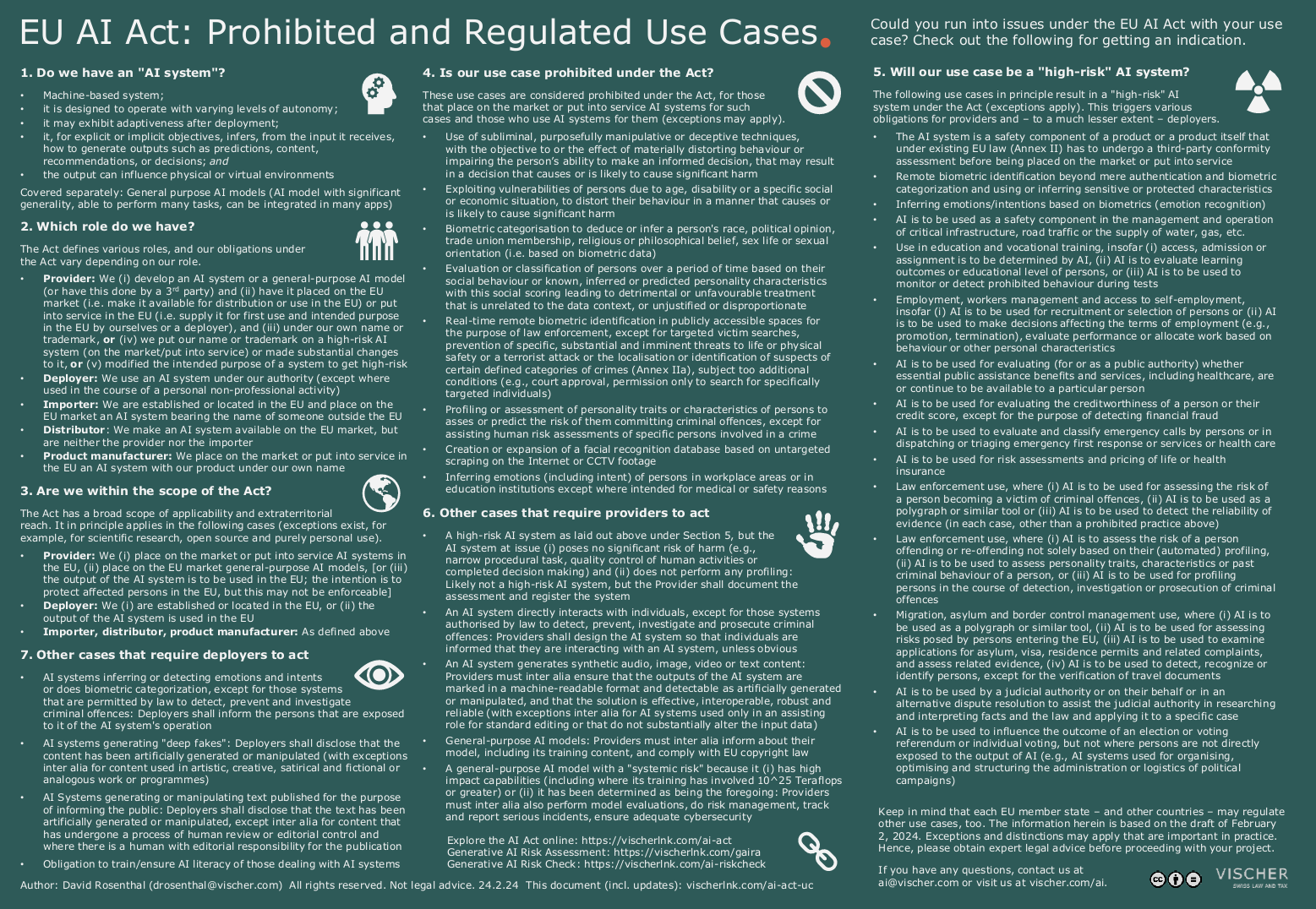
The following one-pager provides an overview of these and the other use cases and definitions of the AIA discussed above:
Where such an HRAIS exists, its provider has a whole range of tasks to fulfil, because it is primarily responsible for ensuring that the requirements set forth in Chapter 2 of the AIA are met by such HRAIS. These requirements for HRAIS are:
- Comprehensive risk management must be ensured, which means that in particular risk assessments are to be done and repeated over the entire lifespan of the HRAIS, supported by corresponding tests of the HRAIS and combined with the implementation of measures to mitigate the identified risks (see the open source GAIRA tool);
- The data used for training, validation and testing must fulfil certain quality criteria and must be subject to far-reaching data governance in order to detect, for example, bias, errors and gaps; Detailed technical documentation for the HRAIS must be created and kept up-to-date, which also proves that the requirements have been met;
- The HRAIS must automatically record the events that occur in logs for the purpose of monitoring its correct functioning over time;
- The HRAIS must be designed and supplied with instructions for use and other guidance so that its users can handle it correctly, understand and assess its output adequately and that they can monitor and control the HRAIS (which includes ensuring that the HRAIS can be safely stopped at any time and is provided in such a way that people do not simply trust the HRAIS);
- The HRAIS must be reasonably accurate and reliable (it is envisaged that the European Commission has to promote the development of appropriate standards) and be resilient regarding errors, faults and inconsistencies;
- The HRAIS must have adequate cybersecurity, especially to protect it against attacks from third parties, both in the area of classical information security as well as AI-specific attacks (see part 6 of our blog series) .
To demonstrate and ensure compliance with these requirements and to enable supervision, providers must:
- Have appropriate documentation of their compliance (up to ten years after placing on the market or commissioning); the necessary evidence must be provided to the competent authorities on request;
- Have a quality management system. If the provider has reason to believe that the HRAIS does not meet the requirements, the necessary corrective measures must be taken immediately (including recalls) and the provider has to inform accordingly;
- Keep the logs generated by their HRAIS in use (for at least six months if they have them);
- Register the HRAIS in an EU database (except those used in the context of critical infrastructure);
- Have a conformity assessment carried out by an appropriate third party;
- Mark the HRAIS with a conformity mark ("CE") and their contact details;
- Operate a system with which they can monitor the HRAIS after it has been placed on the market with regard to technical developments and risks (so-called post-market monitoring system); and
- Carry out an investigation and notify the supervisory authorities if a HRAIS poses a risk to the health, safety or fundamental rights of persons affected or if a serious incident occurs.
An HRAIS provider not based in the EU but subject to the AIA must appoint a representative in the EU ("authorized representative") who has the necessary documentation concerning the HRAIS at hand so that the EU authorities can access them. Special about it is that the representative is itself obliged to resign from the mandate and inform the market surveillance authority if it has reason to consider that the provider is not fulfilling its obligations under the AIA. Importers and distributors of HRAIS also have certain obligations.
Those who "only" use an HRAIS on their own authority, i.e. the deployers, also have obligations under the AIA. In particular, they must ensure that:
- The HRAIS is used in accordance with the instructions for use;
- The HRAIS is monitored by qualified people;
- The logs automatically created by the HRAIS must be kept for at least six months;
- That the input data is relevant and sufficiently representative in view of the intended purpose of the HRAIS;
- The provider is informed about the operation of the HRAIS as part of its post-market monitoring;
- The supervisory authority and the provider (and, if applicable, its distributor) are informed if the deployer has reason to consider that the HRAIS poses a risk to the health, safety or fundamental rights of affected persons - to this end, the HRAIS must be monitored during operation; cooperation with the supervisory authority is required;
- When an HRAIS is used in the workplace, the employees concerned are informed;
- Affected persons are informed when an HRAIS is used for decisions concerning them, even if the HRAIS is only used in a supporting capacity (this goes further than under the GDPR); and
- A fundamental rights impact assessment has been carried out (possibly in combination with a data protection impact assessment) and notified to the supervisory authority if the deployer is a body governed by public law, a private body providing "public services" or it operates an HRAIS for credit assessment, the calculation of a credit score or risk assessment or pricing in the area of life and health insurance; it is not entirely clear whether "public services" also refers to purely private law activities, but this can be assumed on the basis of the considerations; mention is made of services that are provided in the public interest, for example in the areas of education, healthcare, social services, housing and the administration of justice.
These obligations are not exhaustive. In a kind of general clause the AIA grants the supervisory authorities the power to require providers, deployers and other stakeholders to implement further measures – even if HRAIS are used in compliance with the law, should this be necessary to protect the health or safety of affected persons, their fundamental rights or other public interests.
Furthermore, analogous to the GDPR, the AIA provides for a kind of right to information for affected persons in the EU (but not in Switzerland) if a deployer makes a decision based on the output of an HRAIS that has legal or similarly significant effects on the person that are detrimental to their health, safety or fundamental rights. They can then request that the deployer explains to them what role the HRAIS played in the decision and what the key elements of the decision were. This applies to all HRAIS of the 15 categories listed above, with the exception of no. 2. Raising a corresponding claim under the GDPR is also possible; however, data subject rights concerning automated decisions are a bit narrower under the GDPR in that they only relate to fully automated individual decisions.
Due to the extraterritorial application of the AIA for deployers of HRAIS, these obligations may also be relevant for companies outside the EU, even if the provider is not located in the EU but the output of the HRAIS is used in the EU (see above). Whether and how well these obligations can and will be enforced against companies for example in Switzerland is another question. Based on our experience concerning the GDPR, we believe this is rather unlikely as there are significant legal barriers preventing this under Swiss law. However, it should not be possible to impose sanctions on the EU representative who is itself acting properly.
8. Regulation of AI models
It was only late in the legislative process that the AIA was extended to include regulations for providers of certain AI models (the role of the deployer does not exist here). However, only models that can be used for a wide variety of purposes are covered ("general purpose AI model") (GPAIM). However, it is not clear exactly how these are to be distinguished from other models. For example, it could be argued that a model for transcription such as "Whisper" or one that is used only for translations is not a GPAIM. However, if a GPAIM is "specialized" in certain topics such as legal issues through fine-tuning, but can nevertheless be used in many ways, it will probably still be considered a GPAIM.
It is clear from the recitals that GPAIM are not only covered in their actual form, i.e. as files, but also where they are offered via an API (application programming interface), so to speak in the form of "model-as-a-service". Based on an interpretation of the recitals, they are not considered AIS themselves, i.e. the corresponding obligations do not apply because they lack a user interface (there is no explanation why an API is not considered a user interface). Therefore, if OpenAI offers access to GPT4 via an API in addition to "ChatGPT", it does not have to comply with the AIA requirements for AIS within the scope of such API, whereas "ChatGPT" is considered AIS. Anyone who uses the model in their application (insofar as it is considered AIS) is then subject to the AIS requirements with regard to such application; they then become the application's provider because they developed it and used it for themselves. If they place the application on the EU market or use it themselves in the EU, the model will probably also be deemed to have been placed on themarket.
Those who create a GPAIM but only use it internally are not covered by the requirements for GPAIM because they are only deemed to be providers if they place the GPAIM on the market; the "putting into service" trigger referred to in the "provider" definition only applies to AIS and not GPAIM, which is probably due to an oversight (and yet another loophole). According to the recitals, the exceptions should have been defined more narrowly.
GPAIM providers have in particular the following obligations:
- They must maintain and update detailed technical documentation of the model for the attention of the market surveillance authorities;
- They must maintain and update far less detailed documentation of the model for the attention of the users of the GPAIM (i.e. the providers of AIS);
- If they are located outside the EU, they must appoint an authorized representative in the EU;
- They must introduce internal rules (i.e. a strategy) to comply with EU copyright law, including the so-called text and data mining ("TDM") regime and the opt-out right it provides for. The TDM regime allows third parties in the sense of a limiting provision to extract and use content from databases to which they have legitimate access but gives the owners of the rights to the works contained therein an "opt-out" right in relation to applications outside scientific research. Even independently of the AIA, it is not entirely clear how important the TDM regime actually is for the training of AI models and how exactly it is to be implemented operationally, particularly in view of the fact that it is implemented differently at national level. The scope of the AIA requirement is also not entirely clear.
According to a strict interpretation, the new provision of the AIA could make it even more difficult to train AI models, as anyone who wants to offer a GPAIM in the EU will de facto have to comply with EU copyright law when training their model or provide for corresponding instructions, even if they are not subject to this law (for example, Swiss copyright law or US law may offer more or different protections that make it easier to train AI models compared to EU law). This would prevent, say, a US provider from creating an AI model under a less stringent foreign law and then launching it on the EU market. In other words, for the purposes of GPAIM, the AIA would cause EU copyright law to de facto become applicable worldwide, as most providers of GPAIM will want to offer their products also in the EU. The regulation would therefore protect EU providers of general purpose AI models from being disadvantaged by foreign providers.
According to a less strict interpretation, the exact opposite would be the case. EU copyright law would therefore only have to be complied with to the extent that it actually is intended (by itself) to be applied. According to the so-called lex loci protectionis principle, this would only be the case if the training of the AI model took place in the EU, but not in Switzerland or the USA, for example, where local law, which is less strict than in the EU, would apply to the local use of works. EU copyright law would only apply once the AI model is (later on) used in the EU and generates an output there (which may then not infringe EU copyright law, although the question arises as to whether this is not solely a matter for the user of the model). This interpretation is convincing: it can be derived from the text of the AIA, which only requires a strategy to comply with EU copyright law, and not compliance with it outside the EU. This interpretation also respects the internationally recognized lex loci protectionis principle. The required strategy would therefore be to ensure that no training of the AI model takes place in the EU and that copyright law is not infringed there. In any case, the considerations give the impression that the main aim was to ensure that entities training in the EU and relying on the TDM barrier provision take appropriate measures to take opt-outs into account.
Either way, however, it is not entirely clear what is meant by the somewhat unusual provision to launch a "policy to comply". This can be understood to mean that although efforts must be made to comply with EU copyright law (whether applicable or not), this policy does not necessarily have to be successful. The obvious thing to do would have been to formulate a requirement that proof must be provided that EU copyright law has been complied with. This did not happen. Incidentally, the first rights holders have already made public opt-out declarations;
- They must publicly state in summary form ("sufficiently detailed summary") what content they have used to train their models. It is therefore not necessary to prove in detail which content was used for the training; and
- They must cooperate with the European Commission and the national supervisory authorities.
Although the AIA releases GPAIM that are made available under a free and open license from the first three obligations described above, it does not release them from the last two. In addition, the term "free and open" (source) license is defined rather narrowly.
Additional requirements apply to GPAIM providers that entail a "systemic risk". From the legislator's point of view, a GPAIM poses a systemic risk if it can have a significant impact on public health, security, fundamental rights or society in the EU. This should be the case if it is classified as such by the European Commission, for example, or if the high level of efficiency is demonstrated, for example, by corresponding benchmarks or similar. The latter is assumed if a computing power of 10 to the power of 25 FLOPS (="computing operations with fractional numbers") or more has been used for its creation. The large LLMs such as GPT4 from OpenAI are widely assumed to be such GPAIMs with systemic risks although the exact figures are not known. We estimate that they are still just below the aforementioned mathematical limit. However, the AIA is worded openly in this respect either way; "smaller" GPAIMs can also be declared to be GPAIM with systemic risks. Their providers must then additionally evaluate their models with regard to the associated risks, take appropriate measures to address these risks and identify, document and report serious incidents to the market surveillance authorities, including any measures that can be taken in this regard. They must also ensure that GPAIM provide for adequate cyber security.
9. Further obligations for providers and deployers
The AIA also defines some case-specific transparency obligations that apply to all AIS, including those that are not HRAIS. In particular, obligations to mark and label certain AI-generated content are introduced.
Providers must ensure that:
- Persons interacting with an AIS that is intended for this purpose are informed of this fact, unless it is obvious to a reasonable user. A typical violation of this rule can be chatbots which, for example, give the impression that the persons are talking to a real person by using appropriate names and images. However, the requirement can also be relevant for offline communication, such as bots that generate automatic email responses that are not marked as such.
- The text, audio, video and image content generated by an AIS is marked as AI-generated or AI-manipulated. The marks must be machine-readable (but not necessarily recognizable by humans without aids). It is not yet clear how such marks will be implemented in practice, particularly in the case of text (whereas "watermarking" image content is much easier). Although it is not mandatory to offer suitable "AI content detectors" on the basis of these watermarks, these will certainly be offered soon and hopefully more reliable than what is on the market today. Given that AIS is a very broadly defined term, the AIA provides for an exception for AIS according to which AIS, which merely have a supporting function in normal processing operations do not substantially alter the input its significance or are legally authorized for the detection, prevention, investigation or prosecution of criminal offences. Providers of automated translation services such as "DeepL" will try to benefit from this exception; they are fully based on generative AI. Another example would be a tool that increases the resolution of images using AI. Strictly speaking, however, the obligation to mark AI output is formulated in such a way that it would have to be applied to almost every AIS, since almost every AIS outputs text, sound or images in some form (e.g. a text or speech recognition program, an AI that detects defects in products or a recommender system that recommends other products to a buyer in an online store). Of course, this was not the intention of the legislator, who clearly had the output of generative AI in mind, namely content that humans might not otherwise recognize as coming from a machine. In this sense, the condition that the content must be "synthetic" should, according to the meaning and purpose of the regulation, be understood to mean that it is modeled on the content of a human (i.e. not "human"); what is meant is the output of generative AI. The credit score of a customer calculated by an AIS would also be text content, but not "synthetic" content within the meaning of this provision. Finally, it should be noted that the obligation to watermark only applies to the provider: users (and deployers) are free to remove such watermarks.
Deployers must ensure that:
- Affected persons are informed if they are exposed to AIS for recognizing emotions or intentions or categorizing them based on biometric characteristics, provided the AIS processes personal data. Because emotion recognition must also be based on biometric data here (this results from the definition of the term emotion recognition system), the example of sentiment analysis, which is frequently used in practice and is based on text instead of voice, is not included.
- Deep Fakes are identified as such, i.e. as being artificially generated or manipulated content; this does not apply to "evidently artistic, creative, satirical, fictional [or] analogous work or program" insofar such transparency obligations would hamper the display or enjoyment of the work. It will be interesting to see to what extent this exception will also be applied to advertising. -Incidentally, the provision is not intended to protect those about whom a Deep Fake is created (they can defend themselves on the basis of data protection law or special provisions), but those who could be deceived by it: Deep fakes are not banned, but only have to be identified as such.
- Published texts on topics of public interest indicate if they have been AI-generated or manipulated – unless the text has been reviewed by a human and a natural or legal person assumes editorial responsibility for its publication.
The above obligations only apply to AIS, not to GPAIM. Accordingly, if a company like OpenAI offers an AIS such as "ChatGPT", it must ensure that AI content is marked and that such marks are machine-readable. If OpenAI offers access to its models via API (i.e. via an interface for computer programs), though, it does not have to do so. The obligation is then incumbent on the company that uses this API with its own application, which thus becomes an AIS, provided, of course, the company is considered a provider within the meaning of the AIA and falls within its scope because it places the AIS on the EU market or puts it into service in the EU.
If an AIS does not fall under these provisions, is not a HRAIS and if it does not involve any prohibited AI practice, then there are basically no obligations for providers, deployers and the other stakeholders with regard to the operation of the AIS defined under the AIA. However, the AIA encourages them to voluntarily adhere to codes of conduct that will one day be developed for AIS in order to ensure the adherence to ethical principles, careful treatment of the environment, AI literacy, diversity and inclusion and the prevention of negative effects of AI on vulnerable people. Furthermore, an article that was only added in the course of the deliberations of the AIA provides for a kind of AI training obligation for providers and deployers, i.e. they must ensure to the best of their ability that the persons who deal with AIS are adequately trained in them, are informed about the applicable obligations under the AIA and are aware of the opportunities and risks of AIS ("AI literacy"). This applies to all AIS, not just HRAIS. Whether and to what extent this requirement will be enforced remains to be seen.
Some will find the AIA going surprisingly little further in regulating the use of AIS that are neither HRAIS nor implement a prohibited practice - i.e. the majority of cases in practice. This is despite the fact that numerous international initiatives, declarations and even the Council of Europe's AI Convention have repeatedly formulated requirements that have been identified as important for the responsible use of AI, such as the principles of transparency, non-discrimination, self-determination, fairness, prevention of harm, robustness and reliability of AIS, explainability of AI and human oversight (see also our 11 principles). With the exception of selected aspects of transparency, the AIA only requires compliance in the area of HRAIS, and even there primarily from providers. As shown, it does not even allow the processing of special categories of personal data in order to test a "normal" AIS for bias and eliminate it (after all the AIA does not require anyone to do so in the first place). It remains to be seen whether these principles will be enforced in other ways (e.g., via data protection or unfair competition law), via policies and codes of conduct that organizations voluntarily impose on themselves, or not at all.
10. Application in practice
In the following, we have listed some practical examples to show to whom which provision of the AIA can be applied:
| Case | Provider subject to the AIA* | Deployer subject to the AIA* |
|---|---|---|
| A company in the EU provides its employees with "ChatGPT" or "Copilot". They use it to create emails, presentations, blog posts, summaries, translations and other texts and to generate images. | No | Yes |
| The company is located in Switzerland. It is intended that people in the EU will also receive some of the AI-generated content (e.g., as emails or texts on the website). | No | Yes |
| A company in the EU has developed an in-house chat tool based on an LLM and uses it internally to create emails, presentations, blog posts, summaries, translations and other texts and to generate images. | Yes | Yes |
| The company is located in Switzerland. It is intended that people in the EU will also receive some of the AI-generated content (e.g., as emails or texts on the website). | (Yes)1) | Yes |
| A company in the EU uses a specialized application offered on the market for the automatic pre-selection of online job applications. | No | Yes, HRAIS |
| A company in the EU uses "ChatGPT" or "Copilot" to analyze job applicants' documents for any issues. The results remain internal. | Yes2), HRAIS | Yes, HRAIS |
| The company is located in Switzerland and only jobs in Switzerland will be considered, although applicants living in the EU may also apply for them. | No | No3) |
| A company in the EU provides a self-created chatbot on its website to answer general inquiries about the company. | Yes | Yes |
| The company is located in Switzerland. The website is also aimed at people in the EU. | Yes1)4) | Yes |
| A company in the EU uses the product or service of a third party to provide the chatbot on its website. The company's content is made available to the chatbot in the form of a database (RAG) there is no fine tuning. The company does not disclose the provider of the chatbot on the website. | (No)5) | Yes |
| The company states the name of the provider that has supplied the chatbot that has been implemented on the website. ("powered by …") | No | Yes |
| A company in the EU uses an LLM locally to transcribe texts. The Python script used for the task has been obtained from a source on the Internet and implemented without changes. | (No)6) | Yes |
| A company in the EU uses a service from a US service provider that is also offered to customers in the EU to generate avatars for training videos. | No | Yes |
| The company is based in Switzerland. The training videos are only intended for use in Switzerland. | No | No |
Remarks:
According to the definitions of the AIA, the company is not a provider, but it is clear that the legislative intention was to have the AIA apply to it as a provider because the output will be used in the EU.
- According to the definitions of the AIA, the company is not a provider, but it is clear that the legislative intention was to have the AIA apply to it as a provider because the output will be used in the EU.
- This is due to the special rule according to which an AIS becomes a HRAIS if it is used for one of the high-risk applications; in this case, the user becomes the provider.
- There is no use of the AI outputs in the EU, as it concerns jobs in Switzerland only; the nationality or origin of the job applicants should not play a role. The origin of the job applicants (not the nationality) would only be relevant if the outputs of the AI are sent to them (which is not the case here).
- The chatbot is an AIS that is also intended to be used by people who are in the EU. It could therefore be argued that the AIS is also used in the EU or is provided for this purpose (for personal use, because the persons will generally not be deployers) and is therefore commissioned.
- Parametrising an AIS, hooking it up to a database and implementing it within a website should in our view not yet be considered "developing" an AIS; however, the legal situation is not yet clear in that regard. However, the AIS is put into operation under the company's own name.
- It can be argued that adopting the script is equivalent to installing software that has already been developed and, therefore, itself does not constitute development; moreover, the company will not implement it under its own name. If the script is changed, however, the assessment could be a different one.
11. Enforcement
The AIA uses various authorities at the level of the individual member states and the EU to enforce its requirements. For example, GPAIMs are to be supervised by the European Commission, while the supervision of AIS lies with the member states. The AIA further separately regulates the supervision of conformity assessments and declarations on the one hand and the actual market surveillance on the other hand. The system is made even more complicated by the fact that where market supervision already exists (for regulated products and the financial industry), supervision should continue to be carried out by the existing authorities. If an AIS is, in turn, based on a GPAIM of the same provider (e.g., "ChatGPT"), then the newly created central AI Office of the European Commission is responsible for market supervision. Yet, if such an AIS is used in a way that corresponds to a HRAIS, the national market surveillance authorities are again in charge.
The AIA uses various authorities at the level of the individual member states and the EU to enforce its requirements. For example, GPAIMs are to be supervised by the European Commission, while the supervision of AIS lies with the member states. The AIA further separately regulates the supervision of conformity assessments and declarations on the one hand and the actual market surveillance on the other hand. The system is made even more complicated by the fact that where market supervision already exists (for regulated products and the financial industry), supervision should continue to be carried out by the existing authorities. If an AIS is, in turn, based on a GPAIM of the same provider (e.g., "ChatGPT"), then the newly created central AI Office of the European Commission is responsible for market supervision (it is part of the European Commission). Yet, if such an AIS is used in a way that corresponds to a HRAIS, the national market surveillance authorities are again in charge.
The market surveillance authorities are granted far-reaching powers of investigation and intervention by the AIA. This even includes the right to demand the source code of an AIS. They must investigate an AIS if they have reason to believe that there is a risk to the health, safety or fundamental rights of the affected persons or that an AIS is incorrectly not classified as HRAIS. Formal violations (missing declaration, etc.) must also be prosecuted and, of course, any affected person within the EU can report AIA violations to them.
The national market surveillance authorities are naturally limited to their own territory. It is unclear what responsibilities they have in relation to providers and deployers in countries outside the EU such as Switzerland and the USA. If the market surveillance authorities of the individual member states do not agree over the measures to be taken, the European Commission has to decide.
The AIA naturally also provides for administrative fines. Similar to under the GDPR, they should be "effective, proportionate and dissuasive". Overall, the penalties are somewhat more lenient than those under the GDPR. Only the sanctions for prohibited AI practices are significantly higher at 7% of global annual turnover or EUR 35 million, whichever is higher. Otherwise, the fines are capped at a maximum of 3% or EUR 15 million, or even lower in certain cases. Unlike under the GDPR, the AIA states that the interests of SMEs, including start-ups, should be taken into account, which is reflected, among other things, by a rule according to which the maximum penalty for SMEs is to be determined on the basis of the lower as opposed to the higher of the two maximum fine levels provided for by the AIA in the case of AIS. As under the GDPR, negligent violations of the AIA can and should be sanctioned, as well.
12. Transitional provisions
The AIA formally entered into force on the 20th day following its publication in the Official Journal of the European Union, on 1 August 2024. Its provisions will generally apply after a transitional period of 24 months, i.e. from August 2, 2026. However, the following exceptions are provided for:
-
The prohibited AI practices are already banned after six months and the obligation to train employees ("AI Literacy") will also apply from this date, i.e. from February 2, 2025;
-
The regulations on GPAIM and the bodies for performing conformity assessment already apply after twelve months, i.e. from August 2, 2025. This date is also when the regulations on the creation of the authorities and bodies provided for in the AIA Act (such as the AI Office) and the sanctions provisions come into effect;
-
The HRAIS regulations based on existing EU product regulations only apply after 36 months, i.e. from 2 August 2027.
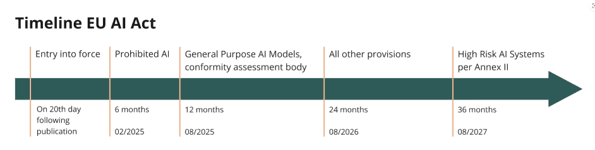
As part of the "AI Pact", the European Commission has called on the private sector to implement the AIA already in advance. We have the impression that a number of companies are keen to respond to this call.
In terms of transitional law, no exception applies to prohibited AI practices that existed at the time the AIA came into force.
For HRAIS that were launched on the market before the AIA, the new regulations only apply if and when there are significant changes to their design. For GPAIMs that were introduced to the market prior to the AIA, the requirements of the AIA must be met within two years of the respective rules coming into force.
13. Concluding remarks and recommendations for action
Whether the AI Act will live up to the high expectations placed on it remains to be seen. The regulation gives the impression that the legislator has attempted to bring an arsenal of defenses into position against an enemy that it does not yet really know and of which it also does not know whether and how it will strike and with what effect.
It is emphasized that the AI Act is designed to be risk-based. This seems indeed to be the case, at least given that it remains (maybe surprisingly) soft in regulating "normal" AI applications, providing for only very few and specific "hard" rules. However, when it comes to applications that are considered to be particularly risky, it is quite comprehensive and expects a lot from providers – and it imposes obligations upon providers for which there are not yet any recognized best practices, such as data quality standards for AI models. Fortunately, these high-risk applications are defined comparatively narrowly and, above all, conclusively, even if the list may be adapted over time. Nevertheless, providers of products that are already regulated according to Appendix I and providers in the area of critical infrastructures will have to deal with these requirements particularly intensively.
For most companies in the EU and to a lesser extent in Switzerland, the AIA will entail work, but this should not get out of hand if they have some control over where AIS is used in-house in their own products and services and those used by third parties. Above all, they will want to ensure that they do not get into the "minefields" of prohibited AIS or HRAIS. If they steer clear of these, they should be able to cope with the few remaining obligations (mainly on transparency) relatively easily, even if they are considered a "provider" because they have developed or further developed an application themselves. One exception may be the obligation to mark AI-generated content; here, suitable standards and ready-to-use solutions are apparently still lacking. It will be interesting to see what the market leaders will offer here, especially for AI-generated texts.
Swiss companies cannot avoid the AIA either, even if it only applies to them to a limited extent and, as in the case of the GDPR, it cannot be assumed that they will be the focus of the EU market surveillance authorities (however, the Swiss Financial Market Supervisory Authority FINMA, for example, has already informally stated that it expects Swiss financial institutions to comply with the AIA insofar as it intends to apply to them). It is not yet clear in all cases whether the AIA will apply to them because mistakes have been made in its drafting. However, it is to be expected that the use of AIS is covered in any case if AI output is sent to recipients in the EU intentionally or is otherwise used within the EU. If a Swiss company offers its customers in the EU market AI functions under its own name as part of its products, services or website, which it has at least partially developed itself, it is also covered. However, as long as it is not a HRAIS, the obligations are moderate.
This means that for most companies, the main effort will be to understand what AI is being used within their own organization and in what form, so that they can react in good time if a project is moving towards one of the aforementioned minefields. When it comes to a HRAIS, companies will be particularly well advised to avoid the role of the provider and, therefore, avoid in-house developments given that the provider is subject to far more obligations than the mere deployer. However, it is not quite that simple, as it can be assumed that measures such as fine-tuning are already considered "development". It remains to be seen to what extent the challenge can be solved in such a way that technology suppliers and integrators assume these obligations as "providers" and this can also be communicated by their customers.
This leads to our recommendation for action: Companies should record all their own AIS and those used by third parties and assess whether and in which role (provider, deployer, distributor, etc.) they will fall under the AIA. Tools available on the market can help with this. It should also be taken into account that the application is limited to Swiss companies; it is not sufficient, for example, for a product or service from the EU to be used or fed with data from persons from the EU. We recommend that companies keep a register of their AI applications, and not only with regard to the AIA. The results in relation to the AIA can also be entered here.
Once these clarifications have been made appropriate guidelines must be issued to ensure that these AIS are not used in a way that leads to a different qualification without prior assessment. Also, in cases where the AIA applies, the resulting obligations must be determined and a plan drawn up as to how these can be implemented within the specified deadlines. This recommendation applies by analogy to new projects. Many Swiss companies have also established the rule that prohibited AI practices are prohibited within their own company by way of instructions, even if the AIA does not formally apply.
In conclusion: Will Switzerland enact its own "AI Act"? The Federal Council intends to announce by the end of 2024 where it sees a need for legislative action in the field of artificial intelligence. However, a Swiss "AI Act" is not to be expected for the time being; a direct adoption does not seem opportune, and the effort for the administration and the economy would probably far exceed the benefits of a Swiss modification, as it is to be expected that many Swiss providers of relevant products will also comply with the AIA - the large international providers anyway. However, the adjustments that are necessary to ensure the continued free movement of goods with the EU and to avoid trade barriers, including the mutual recognition of product approvals, appear to make sense.
A version of this blog first appeared on 27 February 2024 (while the AI Act was not yet final). The text was updated thereafter. A version of this blog with footnotes has appeared in Jusletter on 5 August 2024 (only in German).
Some notable updates since then:
- February 2025: The European Commission defined more specifically what it considers to be an "AI System"; it attempts to carve-out certain de-minimis AI applications, although without a proper legal basis.
- February 2025: The European Commission explained in more detail what it considers prohibited AI activities; notably, the prohibition of emotion recognition in the workplace and educational institutions shall only apply where it is performed on the basis of biometrical data.
- February 2025: The Swiss Federal Council announced its own strategy for regulating AI in Switzerland, which does not foresee adopting the AI Act (see our blog part 23)
- July 2026: With the Digital Omnibus Act on AI (Regulation (EU) 2026/1744), which entered into force on 27 July 2026, the European legislator selectively yet substantially readjusted the AI Act in a total of 42 articles and three annexes to address implementation challenges, simplify compliance requirements, and clarify the governance framework: At the substantive level, the amendment introduces new prohibitions in Art. 5(1)(ba) AIA for AI systems that generate or manipulate realistic sexual content (deepfakes) or child sexual abuse material without consent, flanked by use-related prohibitions in Art. 5(1a) AIA for placing on the market or using such systems where their generation is intended or constitutes a foreseeable outcome in the absence of appropriate technical safeguards. The former provision on data governance for the purpose of detecting bias (Art. 10(5) AIA former version) was transferred to the standalone Art. 4a AIA; accordingly, providers of high-risk AI systems may process special categories of personal data (sensitive personal data) if strictly necessary for bias detection and correction, subject to strict safeguards such as pseudonymisation and the obligation of prompt erasure once correction has taken place. To support companies, the legislator expressly extends privileges – namely access to AI regulatory sandboxes (Art. 57 AIA), guidelines (Art. 70(8) AIA), and simplified technical documentation (Art. 11(1) AIA)—from SMEs to small mid-caps (SMCs); moreover, the amended Art. 63(1) AIA now allows all SMEs (no longer merely microenterprises) simplified quality management systems, while Art. 4 AIA clarifies that providers and deployers are subject to an obligation of best efforts regarding the AI literacy of their staff (supported by Commission measures) rather than a guarantee of success. Institutionally, the EU AI Office is significantly strengthened: Pursuant to Art. 75a–75c AIA, it receives direct enforcement, investigation, and inspection powers, including the authority to impose fines and binding commitments for certain GPAI systems, is equipped with adequate resources pursuant to Art. 64(3) AIA, and can establish its own regulatory sandboxes at Union level pursuant to Art. 57(3a) AIA. Regarding high-risk classification and sectoral interfaces, Art. 6(1a) AIA clarifies that AI systems are not considered safety components if they serve exclusively non-safety-related user support, efficiency enhancement, or quality control; at the same time, Art. 60a AIA enables testing under real-world conditions outside regulatory sandboxes for products under sectoral harmonisation (such as machinery under Annex I Section B AIA), and Art. 2(13) AIA empowers the Commission to derogate from redundant obligations by delegated act, provided that sectoral rules (Annex I Section A AIA) already offer an equivalent or higher level of protection. Finally, the Omnibus Act grants noticeable deadline extensions (Art. 113 AIA): The date of application for high-risk AI systems is postponed to 2 December 2027 for Annex III and to 2 August 2028 for Annex I, the obligation to establish national regulatory sandboxes (Art. 57(1) AIA) is moved to 2 August 2027, and notification is harmonised through the newly inserted Annex XIV with standardised system codes and categories for the designation of notified bodies (Art. 30(2) AIA).
This article is part of a series on the responsible use of AI in companies:
- Part 1: AI at work: The three most important points for employees
- Part 2: Popular AI tools: What about data protection?
- Part 3: AI: 11 principles – and an AI policy for employees
- Part 4: How to assess the risks of both small and large AI projects
- Part 5: AI governance in our company – who is responsible?
- Part 6: The flip side of the coin: Where we need to protect AI from attackers
- Part 7: The EU AI Act - what it means in practice for most companies
- Part 8: AI in financial institutions – opportunities and challenges
- Part 9: AI in marketing: 4 unfair competition law pitfalls
- Part 10: Copyright and AI: Responsibility of providers and users
- Part 11: Fair play with AI: How sports organisations may use athlete data
- Part 12: Feeding AI: How to commercialize data sets
- Part 13: AI in Human Resources
- Part 14: Copyright and AI: How to protect yourself in practice
- Part 15: What you should legally consider when retaining AI providers
- Part 16: How companies can ensure transparency for their use of AI
- Part 17: What is inside an AI model and how it works
- Part 18: The most important compliance requirements for AI
- Part 19: Language models with and without personal data
- Part 20: Risk-based approach: Not all AI applications harbour high risks
- Part 21: The right of access to large language models
- Part 22: Guidelines for using artificial intelligence in financial institutions (FINMA) - VISCHER
- Part 23: Switzerland: What to expect in terms of AI regulation
- Part 24: Five trigger questions for more AI compliance
- Part 25: AI Tools – What about data protection?
- Part 26: AI training: How to Handle Copyright, Data Protection And Other Restrictions
- Part 27: How small and medium-sized enterprises can use AI in a compliant manner
- Part 28: When Media Houses and AI Providers clash – the Pitfalls of AI Regulation
- Part 29: The Challenges of Achieving AI User Adoption
- Part 30: Overview of Key EU Digital Regulations
- Part 31: AI Tools – What about data protection? (2026)
- to be continued...
We support you with all legal and ethical issues relating to the use of artificial intelligence. We don't just talk about AI, we also use it ourselves. You can find more of our resources and publications on this topic here.
Author: David Rosenthal
Service(s) included:
Get in touch with our authors and benefit from their expertise:

David Rosenthal
david.rosenthal@vischer.com
+41 58 211 36 05