16 April 2025
Centralization of Sports Rights - Part 1: An Initial Legal Overview
In an increasingly fragmented media landscape and with fierce competition for viewer attention, higher-level sports organizations repeatedly ask themselves the question: Can the sport achieve better market opportunities and clearer structures for fans, media, and sponsors through a targeted bundling of sports rights? Can it even directly help the sport itself, e.g., through the bundled collection of sports data? Can a lower-tier league or a lesser-known sport gain more members as a result? But how much centralization makes sense – and what are the pitfalls? This series of articles examines the economic and strategic opportunities and risks of centralizing sports rights and presents the initial legal considerations that are essential to observe in such a project.
Listen to this article:
Centralization of Sports Rights - Part 1: An Initial Legal Overview - VISCHER | Podcast on Spotify
Centralization of sports rights as a strategic realignment?
The bundling of certain rights within a sports organization, which can then market these rights in connection with a sport in a specific region or worldwide and also use them for the further development of the sport, is a recurring theme in the sports world. Such centralization can bring economic advantages, especially in competition with other sports or entertainment events, as it expands the commercial possibilities of an organized sport and allows it to react more quickly and effectively to opportunities and dangers in the relevant market and to exploit hidden potentials.
It is therefore not uncommon for higher-level sports organizations (such as the international sports federations responsible for a sport) to ask themselves the strategic question of whether they should centralize certain rights in connection with a top league or competition series in order to make the product more attractive, uniform, and transparent for viewers or to further develop the sport itself. They do this, for example, by collecting data from the league or a competition series centrally (directly on site or based on the TV images produced) and then making it available to the individual subordinate sports organizations for their analysis or for scouting.
Often, however, such rights are fragmented among individual subordinate sports organizations such as regional sports associations, organizers, or marketing companies, which in turn outsource or license the marketing and their own use of their rights to third parties, which naturally results in the quality and content of the organization, transmission or marketing of such events in the same sport varying.
Centralization is also an issue for lower-tier leagues or national associations
Certain international examples of rights centralization are well known and often enjoy broad media attention. One such example is Formula 1, which centrally markets all commercial rights through the Liberty Media Corporation (or its subsidiary). Since the takeover, Liberty Media has achieved considerable revenue growth, in particular through contracts with ESPN and Sky Sports in combination with digital projects (such as the popular Netflix series "Drive to Survive"), and in these deals, it has placed particular focus on attracting new fans. The European football association UEFA also centrally markets the media and sponsorship rights of its club competitions, which leads to considerable revenues that are then distributed among the participating clubs, maximizing the value of the competitions and ensuring a uniform brand presence (i.e., a recognizable event design with comparable commercial usage options). And recently, the International Ski Federation (FIS) also announced that it has agreed with the national associations on the centralization of international media rights in order to offer a competitive global rights package to the media market.
In addition to these prominent examples with international appeal, it is also conceivable that, in particular, a centralization of rights could take place at a lower level, e.g., with a national association or a lower-tier league, so that a national sports organization could market a uniform product across-national leagues (e.g., the transmission of all events of a competition series or a league), in order to achieve additional revenue and/or higher visibility of a possibly lesser-known sport for all participating subordinate sports organizations, some of which provide their infrastructure (such as a stadium) for a single or a few events.
Lower-tier leagues also sometimes offer corresponding solutions in order to offer fans, members, player families, or the wider community of their sport cross-league live streaming, which produces all games cost-effectively (sometimes with autonomously functioning camera work). In Switzerland, for example, Swiss floorball hockey implements this; in addition, there are providers such as RED+ or Asport, which specifically use such streaming solutions in lower-tier leagues. When using such systems, it is also conceivable that performance data is collected across leagues and made available to the participating clubs for game analysis or scouting.
However, all this is only possible for lower-tier leagues or competition series if a central unit is permitted to produce such recordings and also make them available to the participating clubs. In other words: If the rights required for such a project are centralized.
Which sports rights are even eligible for centralization? A differentiation
In order to have a well-informed discussion about the centralization of existing rights, a sports organization that wants to centralize rights must be aware of how these rights can be distinguished from each other so that ultimately the many parties involved in such a project are talking about the same thing and so that the centralizing sports organization can determine which rights are eligible for centralization.
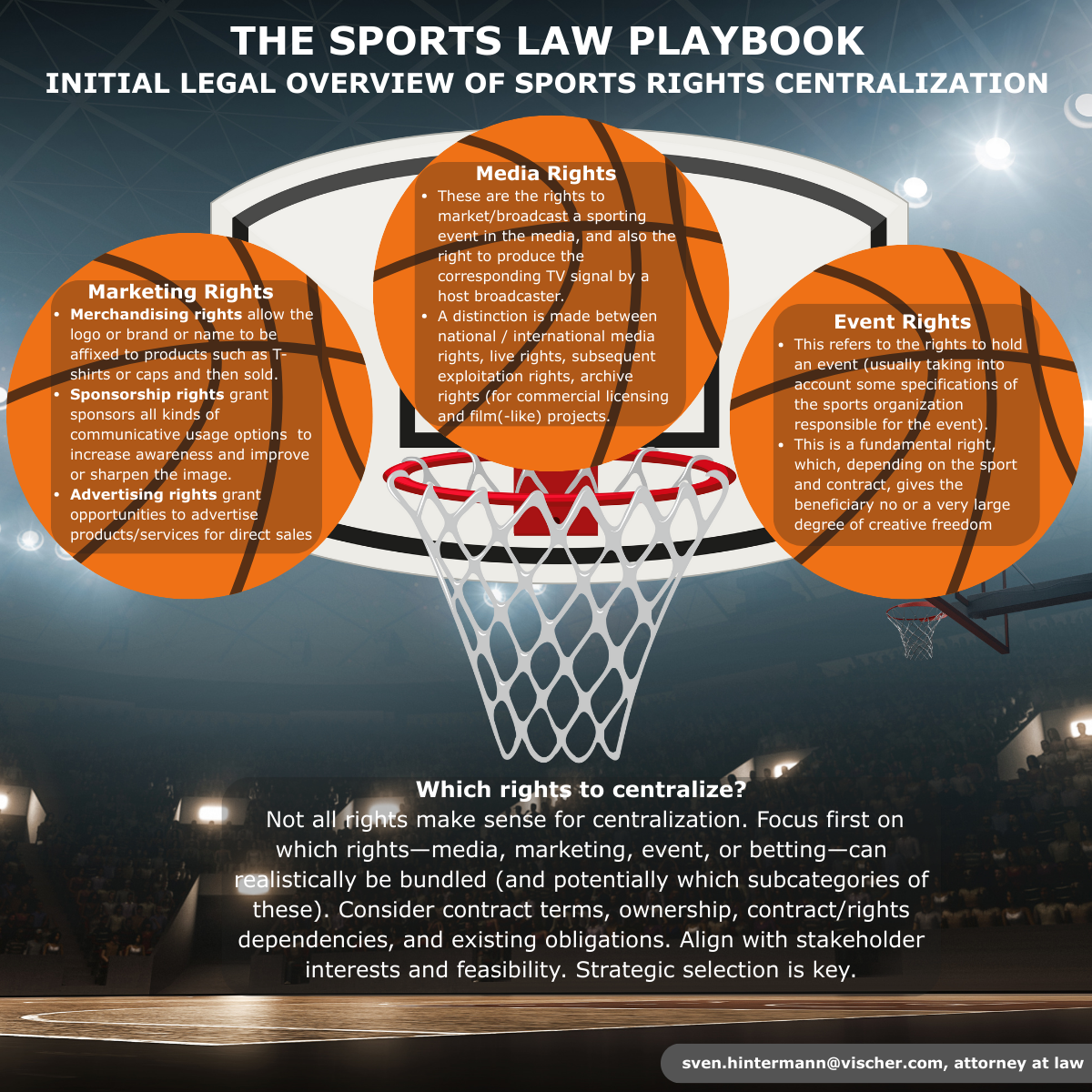
Based on our practical experience, we divide the rights associated with the highest league or competition series of a sport into the following categories for the sake of a simplified presentation – of course, subcategories or other designations are also possible:
1. Media rights – normally the largest source of income for sporting events
- Media rights are the commercial rights to market a sporting event in the media, whereby in this article we mean not only the right to broadcast (via all channels) or sometimes to publicly distribute, but also the right to produce the corresponding TV signal by a host broadcaster (production right). The production right usually extends to the entire competition area over which the organizer of the sporting event also has the right to determine the rules within an existing infrastructure.
- The (international TV) signal consists of the audiovisual footage produced (which in addition to the competition sometimes also contains certain data or timing information, graphic representations such as statistics or standings, background effects, slow-motion images, and other content intended for international broadcasters).
- Whenever the rights to a league or competition series are not held centrally by a single rights holder, for the sake of clarity the regional rights holders often distinguish between national media rights (i.e., the production right and the right to media exploitation in the territory of the country of that regional rights holder – such as the Swiss Radio and Television Corporation SRG, which is allowed to broadcast events of individual sports in Switzerland) and international or continental media rights (i.e., the right to the worldwide or continental marketing of media rights with the exception of the territory of the country of the regional rights holder). The regional rights holders generally assign the international media rights to a third party if they do not want to market the media rights themselves in every country or region of the world (or do not have the necessary capacity or expertise), but rather leave it to a specialized marketing agency or another suitable company.
- In addition to live rights (i.e., the right to broadcast a sporting event live) and certain highlight or subsequent exploitation rights (which mean the time-shifted but often unchanged use of the international signal), archive rights are also gaining in importance these days. This is because in addition to storage and commercial licensing, these regularly also grant the rights holders, the licensing right for film and film-like projects (such as for the Netflix documentary series "Drive to Survive" about Formula 1). Commercial licensing is primarily about the right to further market images from sporting events, for example, if the Italian pasta manufacturer Barilla wants to acquire individual action images from a past match of Roger Federer at an ATP tournament so that Barilla can use these action images for one of its commercials. For a company like Barilla, it is much easier and more customer-friendly if it can contact a central point for this.
- It is also conceivable that the produced signal will be made available to the sports authorities for sports analysis purposes or for scouting; that the images of the produced signal are therefore used to obtain sports performance data. Sometimes sports organizations such as football clubs use further applications to analyze these images.
2. Marketing rights – what are the secondary commercial rights?
- These are all commercial advertising and usage rights to sporting events. In the sports environment, these are mainly sponsorship rights and other advertising rights. Of course, there are also other marketing rights, such as merchandising rights, which allow the logo or brand or name to be affixed to products such as T-shirts or caps and then sold.
- Sponsorship rights grant sponsors, in addition to exclusive access to, and joint projects with, a sport, in particular all kinds of communicative usage options of the sporting events in question to increase awareness and improve or sharpen the image of a sponsor. In return, the sports event organizer normally receives money, although pure benefits in kind (e.g., the provision of sports equipment or technologies) or services are also possible.
- With advertising rights, on the other hand, the advertiser receives opportunities to advertise products or services for direct sales promotion and normally against payment.
3. Event rights – the basis
- This refers to the rights to hold (respectively organize) an event (usually taking into account some specifications of the sports organization responsible for the event). This is a fundamental right, which, depending on the sport and contract, gives the beneficiary either no or a very large degree of creative freedom.
Centralization yes, but which sports rights are worth considering?
Normally, not all media rights or all marketing rights are intended for centralization (and often the sports organization also wants to retain the event rights because otherwise it could lose most of its control over its sport). Usually, individual rights of this kind or their subcategories (which are intended, for example, for regional advertising or national sponsorship rights) remain with the subordinate sports organizations. If a sports organization wants to strategically realign itself by centralizing sports rights, it must begin by analyzing which rights it wants to bundle in order to implement this project as profitably as possible, based on the specific circumstances of its sport and the positions of various stakeholder groups. In addition, such a project should also take place within a foreseeable time frame and ultimately be feasible. However, this always depends on how fragmented the rights are, who owns them, how strong the negotiating position of these owners is, and what their interests are.
Without exception, the subordinate sports organizations always already have ongoing contracts in which they have granted certain sports rights to third parties in a decentralized manner and have entered into obligations. All these subordinate sports organizations may have different contract periods, different contract structures, and different divisions of their rights. Therefore, it is crucial to first examine whether splitting all these contracts at the subordinate sports organization level and centralizing certain rights from these contracts actually makes economic sense.
The following initial considerations can help to determine which sports rights are suitable for a centralization project:
- A sports organization must obtain an overview of the terms of existing media, sponsorship, advertising, and event rights contracts and, in particular, find out about their rights to extend existing contracts (such as any purchase options, exclusive rights of first negotiation, or matching offer rights), which can potentially prevent a centralization project.
- A sports organization must understand and gain an overview of the dependencies of granted sports rights, especially since these cannot be considered in isolation in most cases. For example, those exploiting of media rights always also have an interest in inserting TV sponsorships, commercial insertions, or even virtual advertising (i.e., the virtual covering of advertising media present in the TV image with other advertising) into the international signal and thereby generating additional revenue, although the advertising displayed may affect the (exclusive) rights of sponsors or advertisers, which is often reflected in existing media rights contracts. And the sponsors and advertisers always have an interest in ensuring that the international signal reaches viewers as broadly and as free of charge as possible so that they can maximize the contacts generated (and thus the actual advertising value of a sponsorship or advertising measure). In addition, sports event organizers are repeatedly confronted in contract negotiations with the fact that sponsors insist on a certain quality of the production for the international signal and that it be marketed to certain broadcasters and sometimes even want to stipulate certain minimum broadcasting obligations in their contracts. Sports event organizers must then include such obligations back-to-back in the media rights contracts in order not to violate the sponsorship contracts. In addition, sponsors and advertisers are increasingly operating their own platforms for showing moving images of sporting events, some of which even compete with traditional media offerings (e.g., Red Bull Media or welovesnow.ch from Raiffeisen), or they need more and more moving images from the production of the international signal to produce their own video advertising or to fill their own social media channels with exciting content. The differentiation of these sports rights and contracts is therefore becoming increasingly difficult, which also poses certain challenges for the splitting of such rights in the event of centralization.
- Based on the findings of the information obtained beforehand, the sports organization gets an initial idea of the more or less common denominator of certain sports rights within a reasonable time frame so that it can initiate more targeted negotiations to implement such centralization. It can, for example, concentrate "only" on the centralization of media rights (and even there possibly only on one of the categories mentioned above) or of marketing rights (and there, for example, only on certain rights packages such as title sponsor, timing partner, or similar rights packages). Or it can concentrate on rights related to these decentralized sports rights without touching the existing sports rights. One example would be the central development of an e-sports league that realistically depicts the sport in question, with existing rights exploiters of sporting events in the real world not receiving any rights in connection with these games. Another example would be the exploitation of sports betting rights, i.e., the controlled marketing of media rights and/or rights to data for sports betting operators.
By following the above overview, a higher-level sports organization seeking to centralize sports rights has taken the first step towards achieving that objective. In addition to the overview of the existing sports rights, another initial action should be to clarify if the centralization of certain sports rights actually brings economic added value. Parallel to these initial assessments of possible scenarios, the economic and legal opportunities and risks must also be analyzed. Alongside to sports policy, strategic, and economic considerations, the regulatory framework must also be taken into account. We will address these further initial considerations in our next article on the centralization of sports rights.
Authors: Moritz Jäggy, Sven Hintermann
Service(s) included:
Get in touch with our authors and benefit from their expertise:

Moritz Jäggy
moritz.jaeggy@vischer.com
+41 58 211 32 33

Sven Hintermann
sven.hintermann@vischer.com
+41 58 211 36 81